
Cast-Resin Transformers: Encapsulated and Cast-Coil Technology Explained
Cast-resin transformers are an essential component of modern power transmission and distribution systems. Known for their high safety level, stable performance, and minimal maintenance requirements, these dry-type transformers are widely deployed in environments where fire protection, environmental protection, and operational reliability are critical. By combining epoxy resin encapsulation with advanced cast-coil manufacturing technology, cast-resin transformers deliver excellent insulation strength, strong mechanical stability, and long service life.
This article provides a clear explanation of cast-resin transformer technology, focusing on encapsulation methods, cast-coil manufacturing processes, technical advantages, and practical selection considerations. It is intended to help engineers, project managers, and buyers better understand how to choose reliable cast-resin transformer solutions.
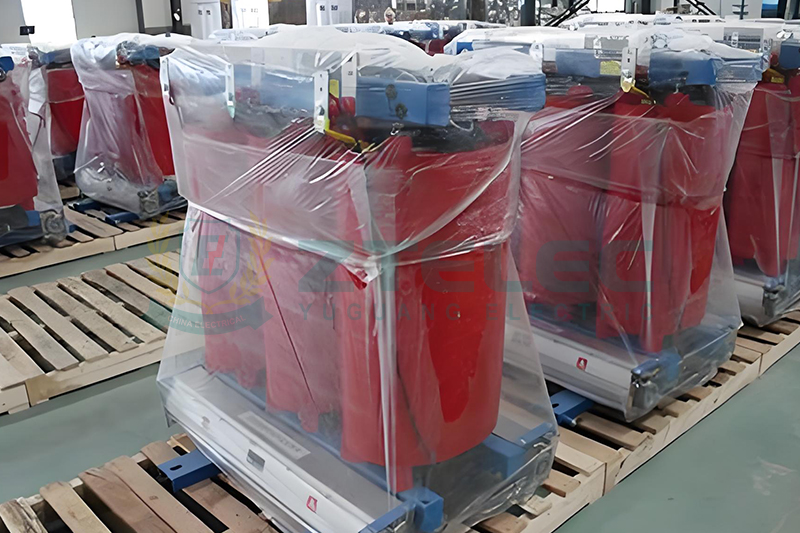
Working Principle of Cast-Resin Transformers
Cast-resin transformers use epoxy resin as the primary insulation and structural reinforcement material. Both high-voltage and low-voltage windings are formed through a vacuum casting process, creating a solid, fully insulated coil structure. Compared with traditional oil-immersed transformers, cast-resin transformers eliminate the risk of oil leakage, fire, and explosion, making them suitable for indoor and safety-sensitive installations.
Due to their sealed insulation system, cast-resin transformers perform reliably in humid, dusty, polluted, or corrosive environments. Typical application scenarios include commercial buildings, data centers, hospitals, metro systems, mining facilities, offshore platforms, and renewable energy projects.
Encapsulation Technology in Cast-Resin Transformers
Encapsulation technology is the core feature that defines cast-resin transformer performance. Through precise control of resin flow, curing temperature, and mold structure, the windings are transformed into a rigid and durable insulation body.
Fully Cast Encapsulated Structure
In fully encapsulated designs, epoxy resin completely surrounds the windings and partially covers the magnetic core. This integrated insulation structure maximizes dielectric strength, ensures uniform electric field distribution, and significantly reduces the risk of partial discharge.
Partial Encapsulation Structure
Partial encapsulation focuses on casting high-voltage windings or key insulation components. This approach balances performance and cost, making it suitable for projects with controlled environmental conditions while still meeting essential safety and insulation requirements.
Mold Design and Optimization
Modern cast-resin transformers use computer-aided simulation to optimize mold design. Factors such as epoxy resin flow behavior, thermal expansion, shrinkage rate, and heat dissipation are carefully analyzed. This improves casting consistency, reduces internal stress, and enhances long-term operational stability.
Technical Advantages of Encapsulation Technology
Encapsulation technology provides multiple technical benefits that directly improve transformer reliability and lifespan.
Electrical insulation performance is significantly enhanced because air gaps within the windings are eliminated, increasing dielectric strength and reducing insulation breakdown risk. Moisture resistance is improved as the sealed resin structure prevents water vapor and condensation from penetrating the insulation system.
Mechanical strength is another key advantage. The rigid epoxy structure enhances resistance to vibration, short-circuit forces, and mechanical shock, making cast-resin transformers suitable for complex installation environments. In addition, epoxy resin materials are flame-retardant and self-extinguishing, greatly improving fire safety during operation.
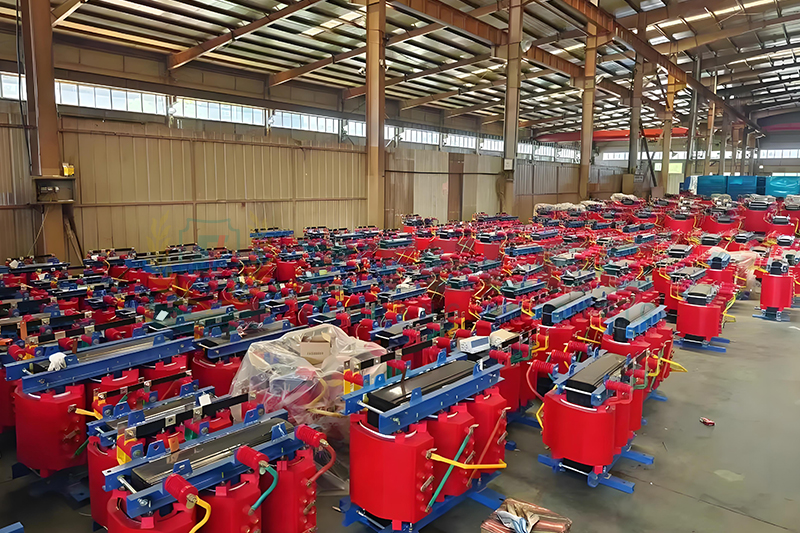
Cast-Coil Manufacturing Process Explained
The cast-coil manufacturing process combines precision winding techniques with controlled vacuum casting and curing procedures. Each stage directly affects the electrical and mechanical performance of the finished transformer.
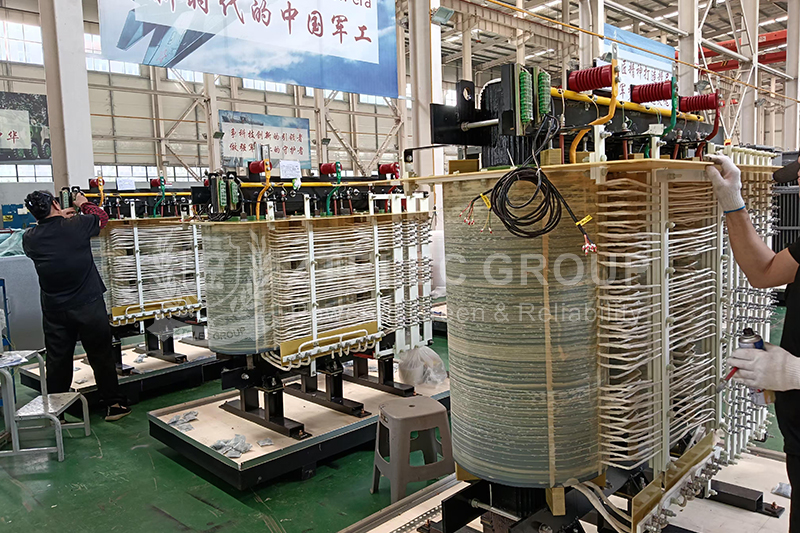
Coil Winding Technology
High-voltage windings typically use foil winding or layered conductor winding to ensure uniform electric field distribution and stable voltage performance. Insulation thickness and interlayer spacing are strictly controlled during winding.
Low-voltage windings are usually made from copper foil or flat copper conductors. This design improves current-carrying capacity while maintaining compact dimensions and strong short-circuit resistance.
After winding, the coils undergo drying, impregnation, and pre-curing processes. These steps ensure strong bonding between the epoxy resin and conductor surfaces, forming a solid insulation interface.
Vacuum Casting and Curing Process
Before casting, molds are thoroughly cleaned, treated with release agents, and assembled with the prepared coils. Epoxy resin and curing agents are mixed under vacuum conditions to remove trapped air and moisture.
During vacuum casting, resin is injected into the mold under negative pressure, ensuring complete penetration and uniform encapsulation of the winding structure. A staged or gradient curing process is then applied to control temperature rise and minimize internal stress.
After demolding, post-curing is carried out to achieve full resin polymerization, ensuring the transformer meets mechanical strength, insulation, and thermal performance requirements.
Selection and Maintenance of Cast-Resin Transformers
Key Selection Considerations
When selecting a cast-resin transformer, it is essential to evaluate load characteristics and capacity requirements to match actual operating conditions. Installation environment factors such as ambient temperature, humidity, altitude, and pollution level should also be carefully considered.
Short-circuit current levels and protection coordination must be analyzed to ensure mechanical and thermal withstand capability. Compliance with applicable energy efficiency and safety standards, including IEC, IEEE, and GB specifications, is equally important. In addition, total life-cycle cost should be assessed, covering procurement, operation, and maintenance expenses.
Maintenance Recommendations
Although cast-resin transformers are largely maintenance-free, routine inspections help ensure long-term reliability. Heat dissipation surfaces should be kept clean to maintain cooling efficiency. Fasteners and electrical connections should be checked periodically to prevent loosening.
Monitoring operating temperature, noise levels, and insulation resistance allows early detection of abnormal conditions. Maintaining detailed operation and maintenance records further supports safe and efficient transformer management.
Cast-resin transformers, based on advanced encapsulation and cast-coil technology, offer outstanding insulation performance, mechanical robustness, and fire safety. Their ability to operate reliably in harsh and safety-sensitive environments makes them an ideal solution for industrial, commercial, and renewable energy applications.
Selecting high-quality cast-resin transformers contributes to stable power system operation while reducing long-term maintenance costs and operational risks. For more information, technical support, or pricing on customized cast-resin transformer solutions, please contact us. Our professional team is ready to provide optimized designs based on your voltage level, capacity, and installation environment.
oil immersed transformer lifespan
oil immersed transformer maintenance
transformer lifecycle
transformer insulation aging
dry type transformer temperature monitoring
- more+releated article
- 2026-05-11How Long Does an Oil-Immersed Transformer Last
- 2026-05-08Modern Power System Dry-Type Transformer Insta
- 2026-05-07Oil-Immersed Transformer Overheating: Causes,
- 2026-05-07Dry-Type Transformers for Data Centers: 2026 R
- 2026-04-30Air-Core Reactor vs Iron-Core Reactor: How to
- 2026-04-29Compact Enclosed Transformer for Smart Grid: T
- 2026-04-2812-Pulse and 24-Pulse Phase-Shifting Transform
- 2026-04-27Oil-Immersed Transformers for Industrial Plant
- 2026-04-25Why Dry-Type Transformers Are Preferred for Ho
- 2026-04-24Enclosed Transformer Outdoor Solutions: IP Pro
- ELECTRICAL INSULATION BOARD MATERIALS
- ELECTRICAL INSULATION MATERIALS
- POWER TRANSFORMER
- ENAMELED WIRE
- SWITCHGEAR


transformer insulation aging
transformer lifecycle
oil immersed transformer lifespan
oil immersed transformer maintenance
dry type transformer installation
dry type transformer temperature monitoring
dry type transformer maintenance
dry type transformer sizing
transformer cooling system failure
transformer overheating causes
oil immersed transformer overheating
transformer oil temperature
harmonic mitigation
dry type transformer
K factor transformer
data center transformer
Cast resin transformer
insulation oil degradation
DGA analysis transformer
transformer fault analysis
oil immersed transformer failure
smart grid transformer
compact enclosed transformer
integrated distribution transformer
compact transformer substation