
How Dry-Type Transformers Improve Power Quality: Harmonics Control, Voltage Stability, and Reliability
When discussing power quality, engineers often think first of active power filters, reactive power compensation, or advanced monitoring systems. Dry-type transformers are sometimes considered passive components with limited influence. However, modern dry-type transformer design has evolved significantly. Today, parameters such as winding configuration, core material, insulation structure, and vector group selection directly affect voltage waveform, harmonic distortion, and supply continuity.
Understanding how dry-type transformers improve power quality requires examining their design and operational characteristics. Rather than acting as simple voltage conversion devices, they play an active role in harmonic management, voltage stability, and system reliability.
Core Mechanism: From Core Material to Winding Design
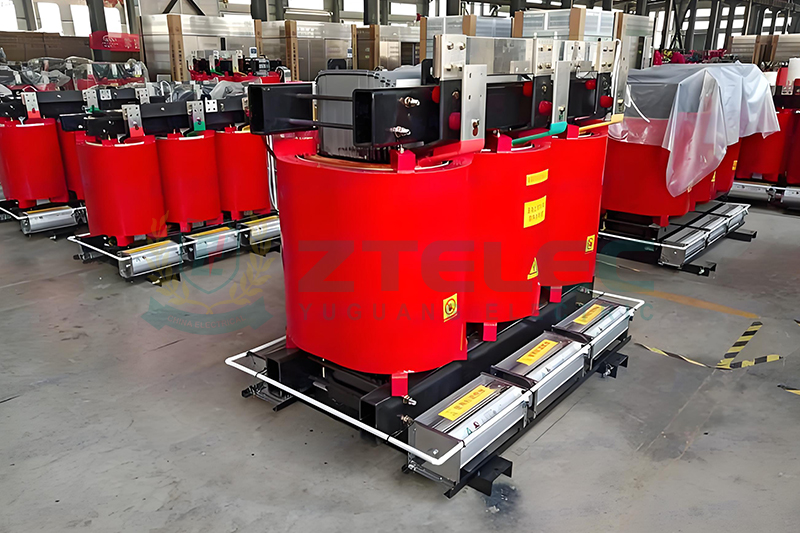
Dry-type transformers contribute to power quality starting with core loss performance. Epoxy resin cast coil transformers typically use high-grade cold-rolled grain-oriented silicon steel, which significantly reduces hysteresis and eddy current losses. Lower core losses reduce no-load reactive power consumption, resulting in a cleaner load profile for the grid.
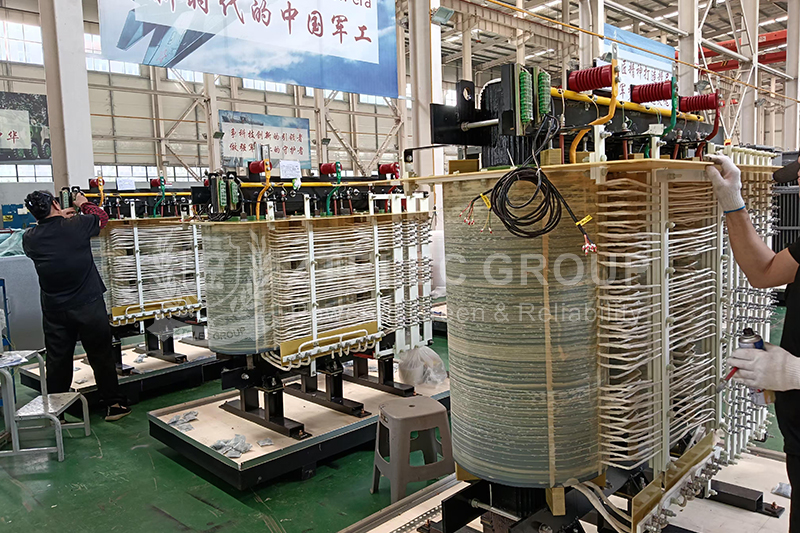
Winding design also influences power quality. High-voltage windings often adopt multi-layer concentric structures, while low-voltage windings use foil winding technology. Foil windings provide uniform leakage flux distribution and stable impedance. Consistent short-circuit impedance ensures predictable voltage drop during load variations, making system compensation easier and improving voltage stability.
Modern energy-efficient dry-type transformers typically achieve low no-load losses relative to rated capacity, provide flexible tap adjustment ranges, and support short-term overload capability. These features collectively enhance system voltage regulation and supply continuity.
Harmonic Management: Vector Group Selection Matters
In systems with nonlinear loads such as data centers, industrial drives, and EV charging stations, third-order harmonics are a major concern. These zero-sequence harmonics are difficult to eliminate using conventional configurations.
Dry-type transformers with D,yn11 vector group provide a natural circulating path for third harmonics. The delta-connected high-voltage winding allows harmonic currents to circulate internally rather than propagating upstream. This effectively isolates low-order harmonics and improves upstream grid power quality.
For advanced harmonic mitigation, split-winding dry-type transformers can be used. Two sets of nonlinear loads are connected to low-voltage windings with a 30° phase shift. This arrangement partially cancels 5th and 7th harmonics, reducing total harmonic distortion (THD) without additional filtering equipment. Such designs are widely adopted in modern data center power distribution systems.
Voltage Stability: Tap Adjustment and Impedance Coordination
Voltage stability is a fundamental aspect of power quality. Dry-type transformers improve voltage performance through tap adjustment and optimized short-circuit impedance.
Most dry-type transformers offer off-circuit tap ranges such as ±2×2.5% or ±2×5%. These taps allow secondary voltage correction without changing system configuration. In distribution networks where voltage drop occurs at load centers, tap adjustment provides a cost-effective voltage regulation solution.
Short-circuit impedance also influences voltage performance. Higher impedance values limit short-circuit currents and reduce voltage sag during disturbances. Lower impedance improves voltage stability during load fluctuations. Selecting appropriate impedance based on load characteristics helps optimize overall power quality.
For impact loads such as large motor starting or stamping equipment, higher impedance dry-type transformers can effectively reduce voltage sag and improve system stability.
Overload Capability and Thermal Stability
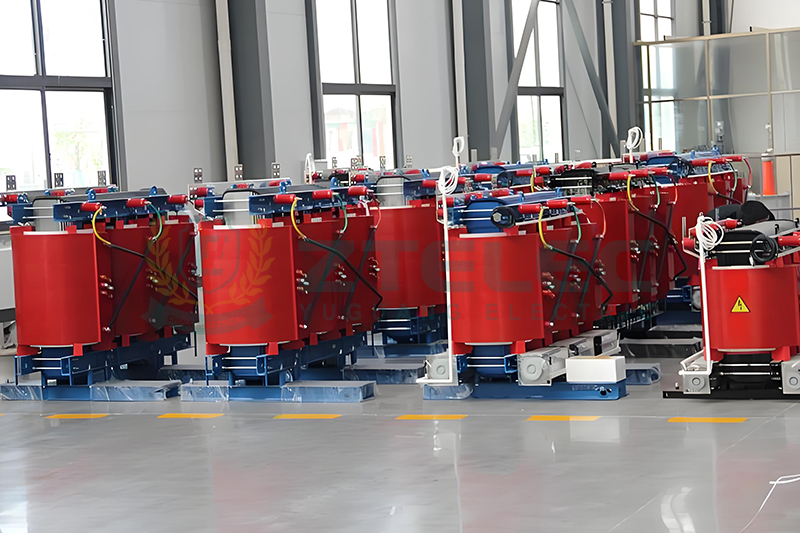
Power interruptions represent the most severe power quality issue. Dry-type transformers with Class F or Class H insulation systems offer superior thermal performance. According to international standards, dry-type transformers can handle significant short-term overloads under controlled temperature conditions. This capability helps maintain supply continuity during temporary load redistribution or grid disturbances.
Modern dry-type transformers are typically equipped with PT100 temperature sensors for continuous winding temperature monitoring. These sensors integrate with building management or substation control systems to provide early warning of abnormal thermal conditions. Preventive thermal monitoring improves operational reliability and reduces unexpected outages.
Additionally, dry-type transformers do not contain insulating oil, eliminating risks associated with oil decomposition and fire hazards. This allows installation closer to load centers, reducing cable length, minimizing voltage drop, and improving end-user voltage quality.
System-Level Optimization
| Application Scenario | Optimization Focus | Power Quality Benefit |
|---|---|---|
| Data Centers | D,yn11 vector group with split windings | Reduced THD and improved harmonic control |
| Industrial Plants | Higher short-circuit impedance | Limited fault current and reduced voltage sag |
| Commercial Buildings | Installation near load center | Reduced voltage drop and improved stability |
| Renewable Microgrids | Low-loss core materials | Improved efficiency and reduced losses |
| Medical Facilities | Isolation transformer configuration | Enhanced protection for sensitive equipment |
Dry-type transformers do more than step voltage levels. Their core materials influence losses, winding structures affect harmonics, impedance selection determines voltage stability, and insulation systems support overload capability. Each design parameter contributes to improved power quality.
Therefore, dry-type transformers should be considered as active components in power quality management during system planning. Proper vector group selection and impedance design can eliminate many power quality issues at the design stage, reducing the need for additional filtering equipment later.
When selecting a dry-type transformer, engineers should evaluate not only rated capacity and efficiency but also its contribution to harmonic reduction, voltage regulation, and system balance. Proper transformer selection can significantly enhance overall power quality and system reliability.
oil immersed transformer lifespan
oil immersed transformer maintenance
transformer lifecycle
transformer insulation aging
dry type transformer temperature monitoring
- more+releated article
- 2026-05-11How Long Does an Oil-Immersed Transformer Last
- 2026-05-08Modern Power System Dry-Type Transformer Insta
- 2026-05-07Oil-Immersed Transformer Overheating: Causes,
- 2026-05-07Dry-Type Transformers for Data Centers: 2026 R
- 2026-04-30Air-Core Reactor vs Iron-Core Reactor: How to
- 2026-04-29Compact Enclosed Transformer for Smart Grid: T
- 2026-04-2812-Pulse and 24-Pulse Phase-Shifting Transform
- 2026-04-27Oil-Immersed Transformers for Industrial Plant
- 2026-04-25Why Dry-Type Transformers Are Preferred for Ho
- 2026-04-24Enclosed Transformer Outdoor Solutions: IP Pro
- ELECTRICAL INSULATION BOARD MATERIALS
- ELECTRICAL INSULATION MATERIALS
- POWER TRANSFORMER
- ENAMELED WIRE
- SWITCHGEAR



transformer insulation aging
transformer lifecycle
oil immersed transformer lifespan
oil immersed transformer maintenance
dry type transformer installation
dry type transformer temperature monitoring
dry type transformer maintenance
dry type transformer sizing
transformer cooling system failure
transformer overheating causes
oil immersed transformer overheating
transformer oil temperature
harmonic mitigation
dry type transformer
K factor transformer
data center transformer
Cast resin transformer
insulation oil degradation
DGA analysis transformer
transformer fault analysis
oil immersed transformer failure
smart grid transformer
compact enclosed transformer
integrated distribution transformer
compact transformer substation