
Ring Main Unit vs Switchgear: Differences, Applications, and Selection Guide
Why Distinguishing RMU and Switchgear Matters
In medium-voltage distribution projects, Ring Main Units (RMUs) and switchgear are the most frequently used primary equipment. However, in tender documents, procurement lists, and design drawings, they are often confused or even considered interchangeable. This misconception can lead to wrong equipment selection, affecting system reliability and lifecycle operation costs.
RMUs and switchgear differ fundamentally in design philosophy, core function, structural form, and applicable grid topology. RMUs serve as load nodes in ring distribution networks, while switchgear acts as hubs for power collection, distribution, and protection in substations and industrial sites. Understanding this distinction is the first step toward proper selection.
This article systematically compares RMUs and switchgear from six dimensions: structure, voltage level, switch and breaker types, protection configuration, installation requirements, and typical applications. A practical selection framework is provided at the end.
Core Concepts: Definitions and Functions
Ring Main Unit (RMU)
An RMU is a compact switchgear for medium-voltage ring networks. Its name comes from the "ring supply" configuration, where multiple distribution transformers connect in a loop along a 10kV bus. Each connection node installs an RMU.
RMUs primarily handle load switching and ring segmentation rather than full short-circuit protection. A standard RMU usually has two ring in/out lines (main load switch) and one or more feeders (fitted with fuses or breakers). Its compact design allows installation in prefabricated substations, underground switchrooms, or outdoor stations.
Functionally, RMUs act as the "final link" in distribution networks, focusing on reliable delivery of medium-voltage power to transformers and fast isolation of faulted sections, ensuring continuous supply to healthy lines.
Switchgear
Switchgear is a complete assembly containing circuit breakers, isolators, current and voltage transformers, protective relays, measuring instruments, and busbars within a metal cabinet. It is widely used in power plants, substations, industrial plants, and large buildings.
The core function of switchgear is power collection, distribution, control, and protection. For example, in a 110kV/10kV substation, multiple switchgear panels form a medium-voltage switchroom, each controlling and protecting one feeder. Switchgear supports full relay protection, including overcurrent, instantaneous, earth fault, and differential protection, capable of interrupting fault currents in milliseconds to safeguard equipment.
Structural Forms and Insulation Medium
RMU Structure
RMUs can be gas-insulated (SF6), solid-insulated, or air-insulated. SF6 RMUs enclose live parts in a sealed gas-filled tank, providing stable insulation, moisture and dust resistance, and long service life (e.g., Schneider RM6, ABB SafeRing). Solid insulation RMUs use epoxy resin to encapsulate live parts, eliminating SF6 for eco-friendly, low-maintenance urban applications.
RMUs are highly integrated, with cabinet widths of 350–600mm. Three functional units (two ring in/out and one feeder) combine to less than 1800mm, ideal for compact urban spaces.
Switchgear Structure
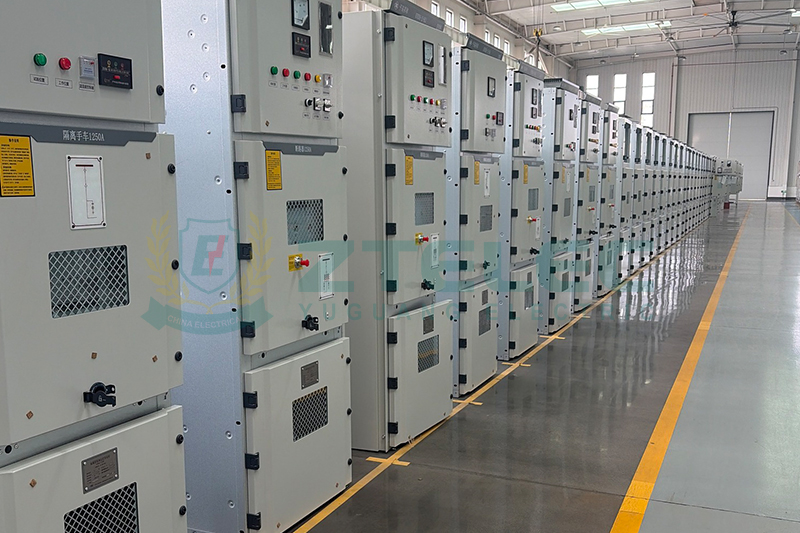
Switchgear is typically fixed type or withdrawable (drawer) type. Fixed type is simple and low-cost but requires power shutdown for maintenance. Withdrawable type allows maintenance with electrical isolation, enhancing operational safety. Common models include KYN28-12 (10kV) and KYN61-40.5 (35–40kV). Cabinets are wider (800–1200mm) and deeper (1500–2000mm).
Gas-insulated switchgear (GIS) integrates breakers, busbars, and isolators in SF6-filled metal enclosures, reducing volume by over 70% compared to air-insulated switchgear while maintaining advanced protection features.
Key Technical Parameter Comparison
| Parameter | RMU | Switchgear |
|---|---|---|
| Rated Voltage | 6–40.5kV (typical 10kV/20kV) | 3–252kV (full range) |
| Main Switch Type | Load switch (feeder may have fuse or breaker) | Vacuum or SF6 circuit breaker |
| Short-Circuit Capacity | Low, relies on upstream breaker | High, can independently interrupt fault current |
| Protection Configuration | Basic (overcurrent, earth fault), some with DTU | Full (instantaneous, overcurrent, differential, earth fault) |
| Cabinet Size | Compact, 300–600mm per unit | Larger, 800–1200mm per unit |
| Number of Circuits | Usually 2–6 | Single per unit, multi-unit for multiple circuits |
| Installation | Floor-mounted, indoor/outdoor | Primarily indoor (GIS can be compact indoor/outdoor) |
| Maintenance | Low (SF6: 10–20 years) | Higher (regular breaker and relay maintenance) |
| Procurement Cost | Lower | Higher (includes protection and measurement) |
| Typical Applications | Prefabricated substations, underground switchrooms, urban ring nodes | Substations, industrial plants, data centers |
Core Difference: Load Switch vs Circuit Breaker
RMUs use load switches, capable of making/breaking load currents, but cannot independently interrupt short-circuit currents. Breakers in switchgear can independently interrupt faults (25–40kA). This defines application boundaries: independent short-circuit protection requires switchgear; ring nodes can use RMU with fuses and upstream protection.
Typical Applications
RMU
RMUs are ideal for "hand-in-hand" urban ring networks. Two 10kV feeders from different stations connect to a series of RMUs, operating one line with the other as backup. When one source fails, loads switch quickly to the other, ensuring dual-source reliability. Common in commercial complexes, metro stations, hospitals, residential areas, and industrial parks.
In prefabricated substations, a compact RMU feeds a transformer efficiently, occupying minimal space and providing fast installation.
Switchgear
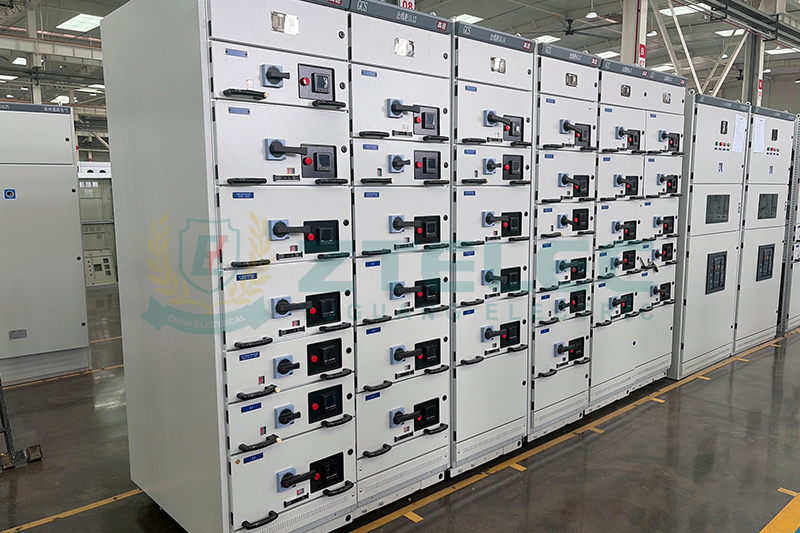
In 10kV switchrooms of 110kV/10kV substations, dozens of KYN28 panels deliver power to the grid and provide full protection. Equipped with CTs, VTs, and microprocessor relays, faults are cleared in milliseconds. In large industrial plants and data centers, switchgear distributes 35kV or 10kV power to transformers, motors, and critical loads. Specialized panels such as motor starters, capacitor banks, and bus couplers highlight switchgear versatility.
Selection Framework
Identify grid topology: ring network node → RMU; substation or multi-feeder node → switchgear.
Assess protection needs: independent short-circuit, grounding, and metering → switchgear; basic load switching → RMU.
Consider space and installation: constrained urban or box-type stations → RMU; spacious rooms with dedicated staff → switchgear.
Calculate lifecycle cost: RMU low cost, long maintenance-free period; switchgear higher initial cost but full protection reduces fault losses.
Common Misconceptions
1. Replacing RMU with switchgear unnecessarily increases cost and installation difficulty.
2. Assuming RMU fuses equal breakers can risk critical loads; use switchgear with breakers where required.
3. Confusing standards: RMU: GB/T 11022, IEC 62271-200; switchgear: IEC 62271-200. Specify applicable standard versions in procurement.
FAQs
Can RMU and switchgear be interchanged? No. RMUs are for ring nodes; switchgear provides full protection and measurement. Selection depends on grid topology and load requirements.
RMU voltage range? Typically 6–40.5kV (mainly 10kV/20kV).
SF6 vs solid-insulated RMU? SF6 offers stable insulation for humid/polluted areas; solid insulation is eco-friendly, low-maintenance.
Switchgear types? Fixed and withdrawable; air-insulated or gas-insulated. Common models: KYN28, GCK, XGN.
RMUs and switchgear are complementary: RMUs for compact, maintenance-free ring nodes; switchgear for comprehensive protection, scalability, and critical power hubs. Understanding their boundaries ensures optimized deployment and reliable urban and industrial power distribution.
oil immersed transformer lifespan
oil immersed transformer maintenance
transformer lifecycle
transformer insulation aging
dry type transformer temperature monitoring
- more+releated article
- 2026-05-11How Long Does an Oil-Immersed Transformer Last
- 2026-05-08Modern Power System Dry-Type Transformer Insta
- 2026-05-07Oil-Immersed Transformer Overheating: Causes,
- 2026-05-07Dry-Type Transformers for Data Centers: 2026 R
- 2026-04-30Air-Core Reactor vs Iron-Core Reactor: How to
- 2026-04-29Compact Enclosed Transformer for Smart Grid: T
- 2026-04-2812-Pulse and 24-Pulse Phase-Shifting Transform
- 2026-04-27Oil-Immersed Transformers for Industrial Plant
- 2026-04-25Why Dry-Type Transformers Are Preferred for Ho
- 2026-04-24Enclosed Transformer Outdoor Solutions: IP Pro
- ELECTRICAL INSULATION BOARD MATERIALS
- ELECTRICAL INSULATION MATERIALS
- POWER TRANSFORMER
- ENAMELED WIRE
- SWITCHGEAR


transformer insulation aging
transformer lifecycle
oil immersed transformer lifespan
oil immersed transformer maintenance
dry type transformer installation
dry type transformer temperature monitoring
dry type transformer maintenance
dry type transformer sizing
transformer cooling system failure
transformer overheating causes
oil immersed transformer overheating
transformer oil temperature
harmonic mitigation
dry type transformer
K factor transformer
data center transformer
Cast resin transformer
insulation oil degradation
DGA analysis transformer
transformer fault analysis
oil immersed transformer failure
smart grid transformer
compact enclosed transformer
integrated distribution transformer
compact transformer substation