
Power Transformer Output Voltage Regulation Methods: Principles, Types, and Engineering Practices
In modern power systems, maintaining stable voltage levels is critical for ensuring safe equipment operation and reliable electricity supply. Transformer output voltage regulation plays a key role in compensating for grid fluctuations, transmission losses, and load variations. This article explains transformer voltage regulation principles, compares no-load and on-load tap changers, and provides practical engineering selection guidance.
Why Transformer Output Voltage Regulation Is Necessary
In real-world power systems, grid voltage is constantly affected by load changes, transmission line impedance, and network configuration adjustments. These variations can cause the secondary voltage of a transformer to deviate from its rated value. Excessively high voltage accelerates insulation aging, while low voltage reduces motor efficiency and may even cause equipment malfunction.
Therefore, regulating transformer output voltage is essential to maintain power quality and operational safety. International and national standards such as IEC and GB/T 1094 define tap range accuracy and allowable deviation, requiring engineers to select appropriate regulation methods based on application conditions.
Basic Principle of Transformer Voltage Regulation
The output voltage of a transformer is determined by the turns ratio between primary and secondary windings. By changing the effective number of turns, the transformation ratio changes, thereby adjusting the output voltage. In engineering practice, this is achieved by installing tapping points on transformer windings and switching between them using tap changers.
Depending on whether voltage adjustment requires de-energization, transformer tap-changing methods are divided into two categories: no-load tap changer and on-load tap changer.
No-Load Tap Changer (NLTC)
No-load tap changing requires the transformer to be de-energized before switching tap positions. Maintenance personnel manually adjust the tap selector to the required position, then re-energize the transformer.
Typical tap range is ±2×2.5%, providing five positions: -5%, -2.5%, 0, +2.5%, +5%. Some designs also offer three-position ±5% configurations. Due to its simple structure and low cost, no-load tap changing is widely used in distribution transformers, industrial plants, and rural power networks where voltage variation is relatively small.
The main limitation is that adjustment requires power interruption, making it unsuitable for applications requiring continuous voltage tracking.
On-Load Tap Changer (OLTC)
On-load tap changers allow tap switching while the transformer remains energized and under load. This ensures uninterrupted power supply during voltage regulation.
OLTC systems incorporate transition resistors or reactors to limit circulating current during switching. Typical tap range is ±8×1.25% or ±9×1.25%, offering higher precision and wider regulation capability. When combined with automatic voltage regulators, OLTC transformers can achieve closed-loop voltage control.
On-load tap changers are commonly used in high-voltage substations, utility grid transformers, data centers, and industrial facilities requiring strict voltage stability. However, they require periodic maintenance due to contact wear.
Voltage Regulation Characteristics of Dry-Type Transformers
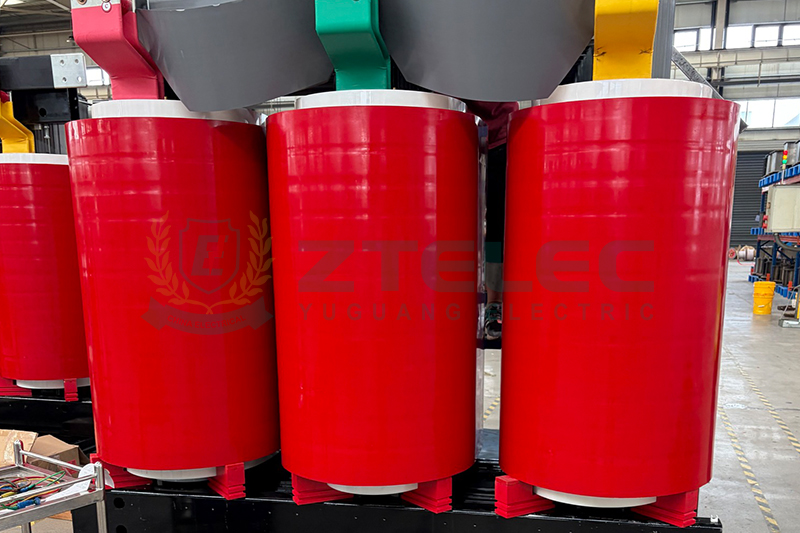
Dry-type transformers use solid insulation materials such as epoxy resin or fiberglass instead of insulating oil. They offer fire safety, low maintenance, and suitability for indoor installations including commercial buildings, hospitals, and metro systems.
Most dry-type transformers use no-load tap changers located on the high-voltage winding. Standard adjustment range is ±2×2.5%. Due to compact structure and typical use in medium- and low-voltage distribution networks, integrating on-load tap changers is uncommon.
Tap adjustment must be performed under full power shutdown conditions with proper safety procedures including grounding and voltage verification.
Voltage Regulation Characteristics of Oil-Immersed Transformers
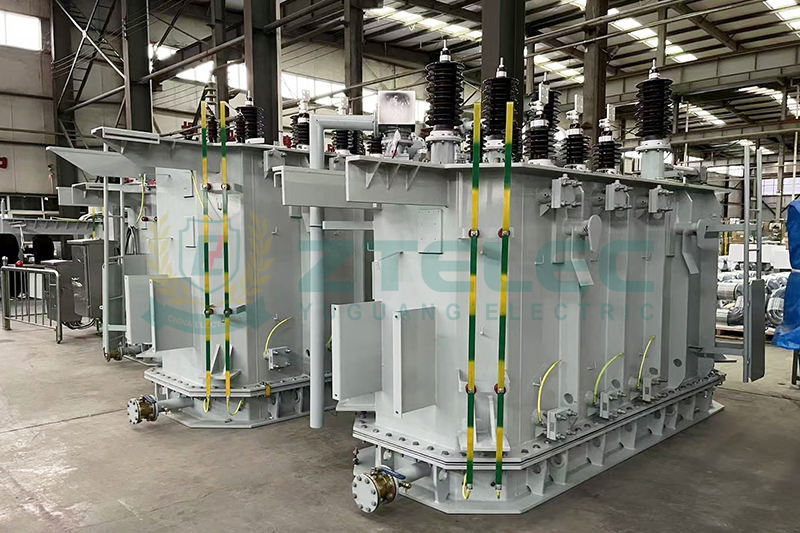
Oil-immersed transformers use insulating oil for cooling and insulation. They are widely used across voltage levels from distribution networks to extra-high-voltage transmission systems.
Small and medium distribution transformers typically adopt no-load tap changers, while large power transformers commonly use on-load tap changers. OLTC mechanisms are immersed in oil, which provides insulation and cooling protection.
However, oil degradation and contamination may occur over time. Regular oil filtration, replacement, and dissolved gas analysis are required to monitor OLTC health.
Comparison Between NLTC and OLTC
| Parameter | No-Load Tap Changer | On-Load Tap Changer |
|---|---|---|
| Operating Condition | Power-off required | On-load operation |
| Adjustment Frequency | Low frequency | Frequent automatic adjustment |
| Tap Range | Typically ±5% | ±10% to ±15% |
| Structure | Simple | Complex |
| Maintenance | Minimal | Periodic maintenance required |
| Typical Applications | Distribution transformers | Substation main transformers |
Selection Recommendations
For distribution systems below 10kV with relatively stable voltage, no-load tap changers are recommended due to lower cost and maintenance requirements. For 35kV and above systems or applications with significant load variation, on-load tap changers combined with automatic voltage regulators provide superior performance.
Operational Precautions
During voltage regulation, several operational considerations must be followed. Tap position must remain within rated range to avoid insulation damage. On-load tap changer operation cycles should be monitored according to manufacturer limits. After adjustment, output voltage must be measured to confirm compliance with allowable deviation. When transformers operate in parallel, tap positions must match to prevent circulating current.
Transformer voltage regulation is essential for maintaining power quality and system stability. Dry-type transformers typically use no-load tap changers for safe indoor distribution applications, while oil-immersed transformers support both no-load and on-load regulation for broader grid requirements. Understanding these regulation methods helps engineers optimize transformer selection and ensure reliable power system operation.
oil immersed transformer lifespan
oil immersed transformer maintenance
transformer lifecycle
transformer insulation aging
dry type transformer temperature monitoring
- more+releated article
- 2026-05-11How Long Does an Oil-Immersed Transformer Last
- 2026-05-08Modern Power System Dry-Type Transformer Insta
- 2026-05-07Oil-Immersed Transformer Overheating: Causes,
- 2026-05-07Dry-Type Transformers for Data Centers: 2026 R
- 2026-04-30Air-Core Reactor vs Iron-Core Reactor: How to
- 2026-04-29Compact Enclosed Transformer for Smart Grid: T
- 2026-04-2812-Pulse and 24-Pulse Phase-Shifting Transform
- 2026-04-27Oil-Immersed Transformers for Industrial Plant
- 2026-04-25Why Dry-Type Transformers Are Preferred for Ho
- 2026-04-24Enclosed Transformer Outdoor Solutions: IP Pro
- ELECTRICAL INSULATION BOARD MATERIALS
- ELECTRICAL INSULATION MATERIALS
- POWER TRANSFORMER
- ENAMELED WIRE
- SWITCHGEAR



transformer insulation aging
transformer lifecycle
oil immersed transformer lifespan
oil immersed transformer maintenance
dry type transformer installation
dry type transformer temperature monitoring
dry type transformer maintenance
dry type transformer sizing
transformer cooling system failure
transformer overheating causes
oil immersed transformer overheating
transformer oil temperature
harmonic mitigation
dry type transformer
K factor transformer
data center transformer
Cast resin transformer
insulation oil degradation
DGA analysis transformer
transformer fault analysis
oil immersed transformer failure
smart grid transformer
compact enclosed transformer
integrated distribution transformer
compact transformer substation