
Dry-Type Transformers for Data Centers: 2026 Guide
What Is a Dry-Type Transformer and Why Data Centers Prefer It
A dry-type transformer is a power transformer that uses air or solid insulation materials instead of transformer oil for cooling and insulation. Compared with oil-immersed transformers, dry-type designs eliminate oil leakage risks, improve fire safety, and reduce maintenance requirements. These characteristics make them ideal for environments with strict safety standards such as data centers, hospitals, and commercial buildings.
In 2026, rapid growth in AI computing infrastructure is accelerating global data center construction. High-density GPU clusters and liquid-cooled racks are dramatically increasing power density requirements. As a result, dry-type transformers have become a critical component in modern data center power distribution systems, ensuring reliable and safe operation under demanding load conditions.
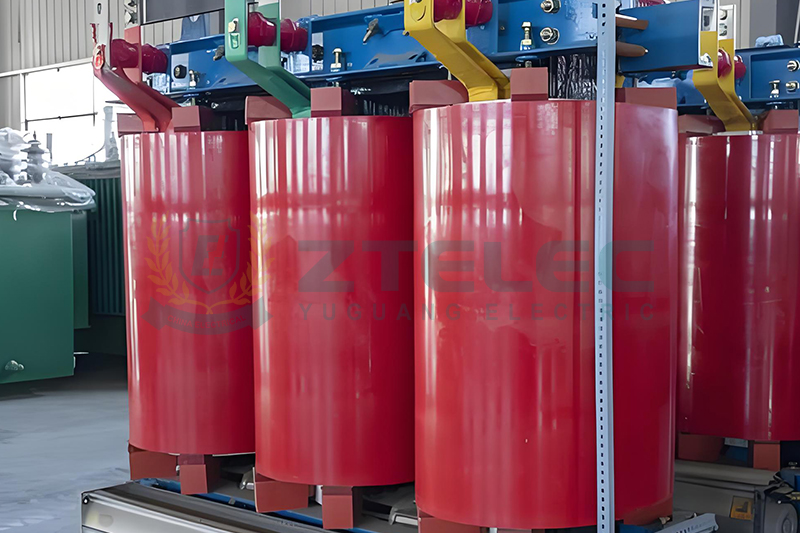
Working Principle of Dry-Type Transformers
Dry-type transformers consist of a magnetic core and windings. Electrical energy is transferred from the high-voltage winding to the low-voltage winding through electromagnetic induction. Instead of transformer oil, epoxy resin casting or F-class and H-class insulation materials provide dielectric strength and thermal stability.
Two main cooling methods are used in data center applications. Natural air cooling relies on convection and is suitable for medium capacities up to approximately 1600 kVA. Forced air cooling uses fans to enhance heat dissipation and can increase transformer capacity by 20% to 30%, making it suitable for high-density data center deployments.
In most data centers, dry-type transformers step down medium voltage such as 10 kV or 20 kV to low voltage levels like 0.4 kV, supplying power to UPS systems and power distribution units.
Key Requirements for Data Center Dry-Type Transformers in 2026
High Power Density Adaptation
AI training clusters now exceed 100 kW per rack, with some liquid-cooled configurations surpassing 200 kW. Transformers must handle significantly higher load density within limited space. Typical capacity requirements range from 1600 kVA to 4000 kVA, while hyperscale facilities may require up to 6300 kVA per unit.
Harmonic Mitigation Capability
UPS systems and switching power supplies generate harmonic currents, particularly the third, fifth, and seventh harmonics. These harmonics increase transformer losses and temperature rise. Selecting D,yn11 vector groups helps suppress third harmonics, while K-factor rated transformers such as K-13 or K-20 are designed for nonlinear loads. Copper foil windings further reduce eddy current losses.
Thermal Response and Protection
Data center loads fluctuate rapidly, especially during AI inference bursts. Transformers should include PT100 temperature sensors, over-temperature alarm and trip protection, and communication interfaces. Typical alarm and trip settings for H-class insulation are 155°C and 170°C respectively. Integration with DCIM or BMS platforms via Modbus RTU or BACnet enables real-time monitoring.
Energy Efficiency Requirements
Energy efficiency is critical for sustainable data centers. Selection should consider no-load loss, load loss, and overall efficiency. High-grade grain-oriented silicon steel or amorphous alloy cores significantly reduce no-load losses. Products meeting Tier 2 efficiency requirements or equivalent energy standards are recommended for new projects.
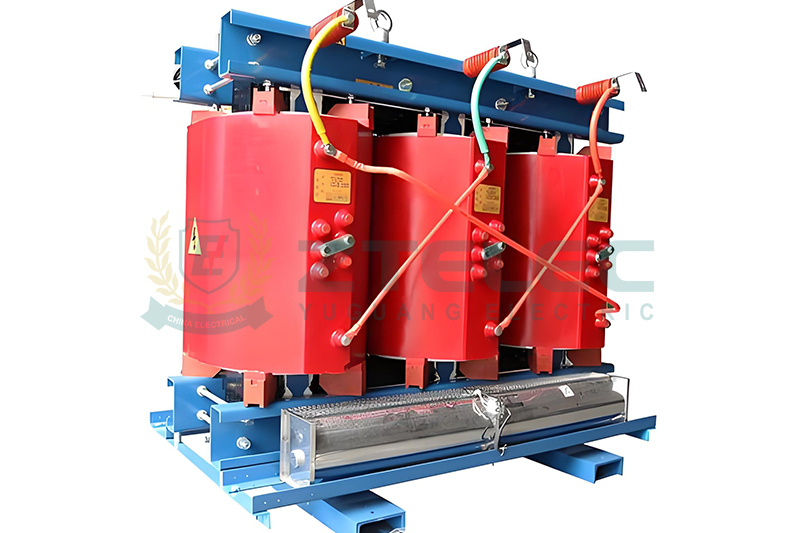
Dry-Type Transformer Selection Parameters for Data Centers
| Parameter | Recommended Range | Description |
|---|---|---|
| Rated Capacity | 800 kVA to 4000 kVA | Typically selected as total IT load multiplied by 1.25 |
| Voltage Ratio | 10 kV / 0.4 kV | Based on site medium voltage level |
| Insulation Class | F Class or H Class | H Class recommended for harmonic-rich environments |
| Vector Group | D,yn11 | Reduces third harmonic circulation |
| Protection Level | IP20 / IP23 / IP44 | Higher rating for humid environments |
| K-Factor | K-13 to K-20 | Designed for nonlinear loads |
| Cooling Method | AN or AF | AF recommended for high-density installations |
| Noise Level | ≤55 dB | Important near office areas |
| Temperature Monitoring | PT100 + communication | Supports remote monitoring |
Installation Considerations for Data Centers
Adequate spacing around the transformer is essential for ventilation and maintenance. A minimum clearance of 600 mm is recommended. Proper airflow design must be considered for both natural and forced cooling systems. In seismic regions, vibration isolators and anchoring bolts should be installed to enhance stability.
Coordination with UPS Systems
When supplying double-conversion UPS systems, transformer short-term overload capability must be evaluated. UPS charging inrush current may reach six to ten times rated current. Harmonic impedance matching should also be analyzed using simulation tools to ensure system stability.
Recommended Preventive Maintenance Schedule
| Maintenance Item | Recommended Frequency |
|---|---|
| Infrared thermal inspection | Quarterly |
| Insulation resistance test | Annually |
| Winding resistance measurement | Every two years |
| Core grounding current check | Annually |
| Dust cleaning | Every six months |
Technology Trends for 2026 and Beyond
Amorphous alloy core transformers are gaining popularity due to extremely low no-load losses, making them suitable for green data centers. Digital monitoring systems and IoT-enabled smart transformers allow predictive maintenance and improved reliability. Modular prefabricated substations integrating transformers and switchgear significantly shorten installation timelines.
Selecting dry-type transformers for data centers in 2026 requires balancing power density, harmonic performance, efficiency, and intelligent monitoring capabilities. Early collaboration with transformer manufacturers and system-level harmonic analysis ensures optimal performance, improved reliability, and long-term energy savings for modern data center infrastructure.
oil immersed transformer lifespan
oil immersed transformer maintenance
transformer lifecycle
transformer insulation aging
dry type transformer temperature monitoring
- more+releated article
- 2026-05-11How Long Does an Oil-Immersed Transformer Last
- 2026-05-08Modern Power System Dry-Type Transformer Insta
- 2026-05-07Oil-Immersed Transformer Overheating: Causes,
- 2026-05-07Dry-Type Transformers for Data Centers: 2026 R
- 2026-04-30Air-Core Reactor vs Iron-Core Reactor: How to
- 2026-04-29Compact Enclosed Transformer for Smart Grid: T
- 2026-04-2812-Pulse and 24-Pulse Phase-Shifting Transform
- 2026-04-27Oil-Immersed Transformers for Industrial Plant
- 2026-04-25Why Dry-Type Transformers Are Preferred for Ho
- 2026-04-24Enclosed Transformer Outdoor Solutions: IP Pro
- ELECTRICAL INSULATION BOARD MATERIALS
- ELECTRICAL INSULATION MATERIALS
- POWER TRANSFORMER
- ENAMELED WIRE
- SWITCHGEAR



transformer insulation aging
transformer lifecycle
oil immersed transformer lifespan
oil immersed transformer maintenance
dry type transformer installation
dry type transformer temperature monitoring
dry type transformer maintenance
dry type transformer sizing
transformer cooling system failure
transformer overheating causes
oil immersed transformer overheating
transformer oil temperature
harmonic mitigation
dry type transformer
K factor transformer
data center transformer
Cast resin transformer
insulation oil degradation
DGA analysis transformer
transformer fault analysis
oil immersed transformer failure
smart grid transformer
compact enclosed transformer
integrated distribution transformer
compact transformer substation