
Phase-Shifting Rectifier Transformer for Medium Voltage Drives: Principles, Benefits & Selection Guide
In high-power applications such as industrial variable frequency drives, rail traction systems, electrolysis processes, and renewable energy integration, medium voltage inverters require exceptionally stable and low-distortion DC bus power. The phase-shifting rectifier transformer (PST), as the core component of multi-pulse rectification systems, plays a critical role in harmonic mitigation and power quality improvement, making it an essential solution for modern power electronics systems.
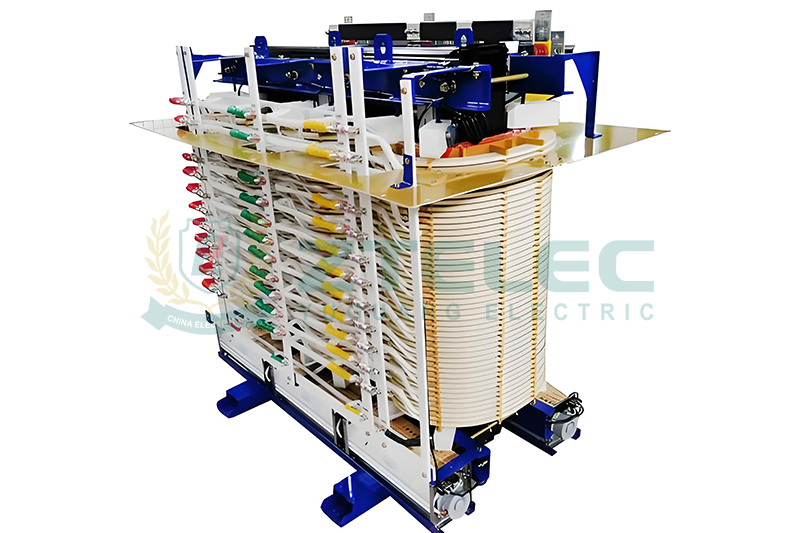
What Is a Phase-Shifting Rectifier Transformer?
A phase-shifting rectifier transformer is a specialized transformer equipped with multiple secondary windings, each having a defined phase displacement. By introducing phase shifts such as 15°, 7.5°, or 5°, the outputs of multiple rectifier bridges are time-shifted and combined, forming multi-pulse rectification systems such as 12-pulse, 18-pulse, or 24-pulse configurations.
In a typical 12-pulse system, one primary winding feeds two secondary windings connected in delta (Δ) and star (Y) configurations, creating a 30° phase shift. These windings supply two 6-pulse rectifier bridges. Higher pulse systems, such as 18-pulse and 24-pulse, utilize three or four secondary windings with precise phase angles to further reduce harmonic distortion.
Why Medium Voltage Inverters Require PST Transformers
Medium voltage inverters (2.3kV, 3.3kV, 4.16kV, 6kV, 10kV) typically use rectifier stages to convert AC to DC before inversion. Conventional 6-pulse rectifiers generate significant harmonic currents, including 5th, 7th, 11th, and 13th harmonics, leading to total harmonic distortion (THD-I) levels of 20%–30%.
By adopting multi-pulse rectification through phase-shifting transformers, the characteristic harmonics shift to higher orders (12k±1 or 18k±1), significantly reducing low-order harmonics. This allows THD-I to drop below 5%, and in advanced designs, below 3%, meeting standards such as IEEE 519 without requiring additional active filters.
Key Technical Parameters
| Parameter | 12-Pulse | 18-Pulse | 24-Pulse |
|---|---|---|---|
| Pulse number | 12 | 18 | 24 |
| THD (AC side) | ≤ 8% | ≤ 5% | ≤ 3% |
| Lowest harmonic order | 11th | 17th | 23rd |
| Typical capacity range | 200 kW – 2 MW | 500 kW – 5 MW | > 1 MW |
| Power factor | > 0.95 | > 0.96 | > 0.97 |
| Efficiency | ≥ 98.5% | ≥ 98.5% | ≥ 98% |
Additional performance requirements include high insulation strength for medium voltage systems, precise phase displacement control within ±0.5°, and optimized short-circuit impedance to balance circulating currents and maintain DC bus stability.
Winding Connections and Phase-Shifting Principles
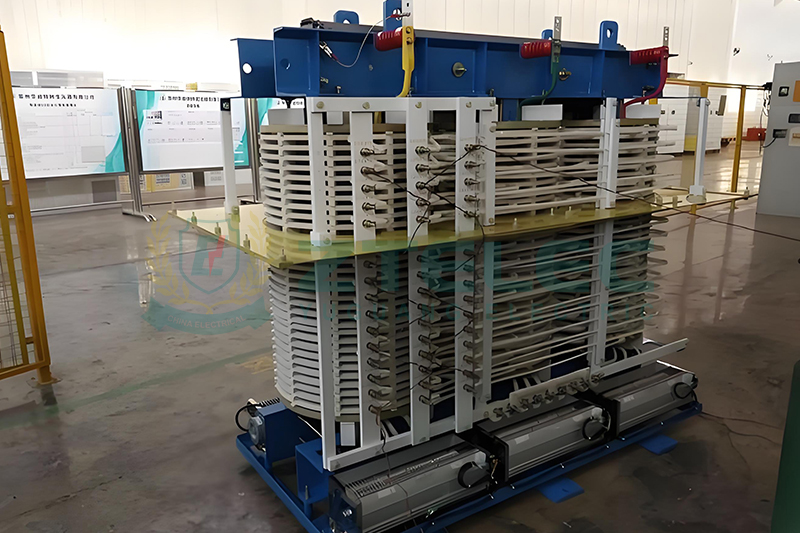
The phase shift in PST transformers is achieved through advanced winding configurations. Extended delta connections enable flexible phase adjustments beyond standard angles. Zigzag (interconnected star) configurations allow precise control by splitting windings across core limbs. Multi-winding structures combine different connection types to achieve high pulse numbers with excellent phase accuracy.
In a 12-pulse system, the delta winding introduces a 30° phase shift relative to the star winding, doubling the ripple frequency and reducing ripple amplitude, thereby lowering DC filtering requirements.
Typical Applications
Phase-shifting rectifier transformers are widely used in high-voltage variable frequency drives for motors such as pumps, compressors, and fans. In rail traction systems, they improve input power quality and reduce grid disturbances.
In electrochemical industries, such as aluminum smelting and chlor-alkali production, they ensure low ripple DC power. Data centers and HVDC systems benefit from improved harmonic performance and stable power supply.
They are also increasingly used in large-scale energy storage and renewable power conversion systems, where harmonic control and system efficiency are critical.
Selection Guidelines
When selecting a PST transformer, engineers must consider pulse number, system capacity, harmonic limits, and cost. Typically, 12-pulse systems are suitable for applications below 1 MW, while 18-pulse systems are recommended for 1–5 MW. For higher capacities or stricter harmonic requirements, 24-pulse solutions or active front-end designs may be required.
Transformer capacity should be sized at 1.1–1.2 times the inverter rating to ensure thermal margin. Cooling methods include oil-immersed (ONAN/ONAF) for large capacity and dry-type (AN/AF) for indoor or environmentally sensitive installations.
Attention must also be given to DC bias effects, which can cause core saturation and increased losses. Advanced designs mitigate this through optimized core structures and material selection.
Standards and Manufacturers
Key international standards include IEC 60076, IEC 61378, IEEE C57, and GB/T 5585. Leading manufacturers include ABB, Siemens, Schneider Electric, TBEA, and other global transformer suppliers, with continuous advancements in high-pulse transformer technologies.
Phase-shifting rectifier transformers are fundamental to achieving high power quality in medium voltage inverter systems. By effectively reducing harmonics and improving efficiency, they support reliable and energy-efficient industrial operations.
As harmonic regulations become stricter and energy efficiency demands increase, multi-pulse PST transformers will continue to play a vital role in advanced power systems. Early-stage integration and proper selection are essential for optimizing system performance and lifecycle cost.
oil immersed transformer lifespan
oil immersed transformer maintenance
transformer lifecycle
transformer insulation aging
dry type transformer temperature monitoring
- more+releated article
- 2026-05-11How Long Does an Oil-Immersed Transformer Last
- 2026-05-08Modern Power System Dry-Type Transformer Insta
- 2026-05-07Oil-Immersed Transformer Overheating: Causes,
- 2026-05-07Dry-Type Transformers for Data Centers: 2026 R
- 2026-04-30Air-Core Reactor vs Iron-Core Reactor: How to
- 2026-04-29Compact Enclosed Transformer for Smart Grid: T
- 2026-04-2812-Pulse and 24-Pulse Phase-Shifting Transform
- 2026-04-27Oil-Immersed Transformers for Industrial Plant
- 2026-04-25Why Dry-Type Transformers Are Preferred for Ho
- 2026-04-24Enclosed Transformer Outdoor Solutions: IP Pro
- ELECTRICAL INSULATION BOARD MATERIALS
- ELECTRICAL INSULATION MATERIALS
- POWER TRANSFORMER
- ENAMELED WIRE
- SWITCHGEAR



transformer insulation aging
transformer lifecycle
oil immersed transformer lifespan
oil immersed transformer maintenance
dry type transformer installation
dry type transformer temperature monitoring
dry type transformer maintenance
dry type transformer sizing
transformer cooling system failure
transformer overheating causes
oil immersed transformer overheating
transformer oil temperature
harmonic mitigation
dry type transformer
K factor transformer
data center transformer
Cast resin transformer
insulation oil degradation
DGA analysis transformer
transformer fault analysis
oil immersed transformer failure
smart grid transformer
compact enclosed transformer
integrated distribution transformer
compact transformer substation