
315 kVA Transformers for Commercial Buildings: Cast Resin or Oil Immersed?
The 315 kVA transformer is one of the most widely used power distribution capacities in commercial buildings, widely adopted in office towers, commercial complexes, hotels, hospitals, schools and public facilities. For most standard commercial floors ranging from 2,000 to 4,000 square meters, a single 315 kVA distribution transformer can deliver stable power supply, making it the most common specification adopted by design institutes, electrical contractors and EPC projects.
Nevertheless, despite identical 315 kVA capacity, cast resin dry type transformers and oil immersed transformers show stark differences in fire codes, installation methods, operation & maintenance, upfront purchase cost and long-term operational expenses. There is no universal solution fitting all projects.
Combined with typical application scenarios of commercial buildings, this article conducts systematic analysis from multiple dimensions including fire safety, installation environment, operational efficiency, maintenance cost and Total Cost of Ownership (TCO), to help purchasers, design engineers and project owners complete reasonable selection efficiently.
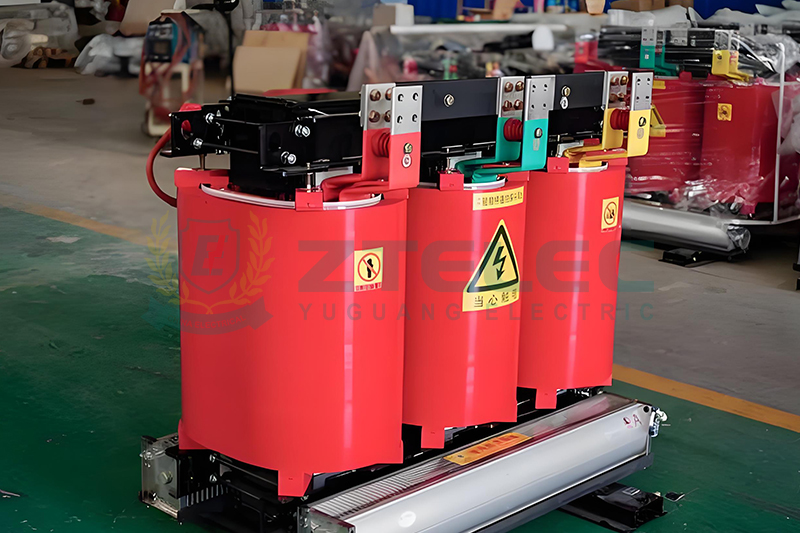
Why Is 315 kVA the Most Common Transformer Capacity for Commercial Buildings?
Compared with smaller capacity models such as 160 kVA and 200 kVA, the 315 kVA unit covers broader commercial loads, while avoiding the larger footprint and higher initial investment required by transformers of 500 kVA and above. Therefore, it becomes the golden capacity for commercial power distribution systems.
Typical applications include:
Floor power distribution systems in high-rise office buildings; commercial complexes and shopping centers; public buildings including hotels, hospitals and schools; underground parking lots and charging stations; auxiliary power supply for data centers; rail transit and municipal public facilities.
For the vast majority of commercial buildings, transformers are usually installed in basements, mechanical floors or floor electrical rooms. Hence, fire codes often serve as a decisive factor for product type selection.
Overview of Cast Resin Dry Type Transformers vs Oil Immersed Transformers
| Comparison Item | Cast Resin Dry Type Transformer | Oil Immersed Transformer |
|---|---|---|
| Insulation Medium | Epoxy resin casting | Mineral insulating oil |
| Fire Safety Performance | ★★★★★ | ★★★☆☆ |
| Indoor Installation | Highly suitable | Many restrictions apply |
| Purchase Price | Higher | Lower |
| Maintenance Requirement | Nearly maintenance-free | Periodic oil quality testing required |
| Heat Dissipation Capacity | Good | Excellent |
| Overload Capacity | Fairly strong | Superior |
| Typical Application | Commercial buildings, hospitals, data centers | Industrial parks, outdoor substations |
Fire Safety: The Top Priority for Commercial Building Transformer Selection
For commercial buildings, fire design requirements usually weigh more heavily than equipment procurement cost.
Advantages of Cast Resin Dry Type Transformers
Cast resin transformers feature windings fully encapsulated with epoxy resin, containing zero insulating oil with no risk of oil leakage or combustion. Compliant with IEC 60076-11 and GB/T 10228 standards, the units achieve F1 fire resistance grade, and certain models meet higher fire performance criteria.
Accordingly, cast resin transformers can be directly installed in indoor electrical rooms without independent oil containment pits, oil drainage systems or dedicated fire suppression equipment, drastically simplifying fire protection design.
Cast resin transformers have become the mainstream industry solution for densely occupied premises including hospitals, office towers, shopping malls, schools and rail transit facilities.
Fire Code Requirements for Oil Immersed Transformers
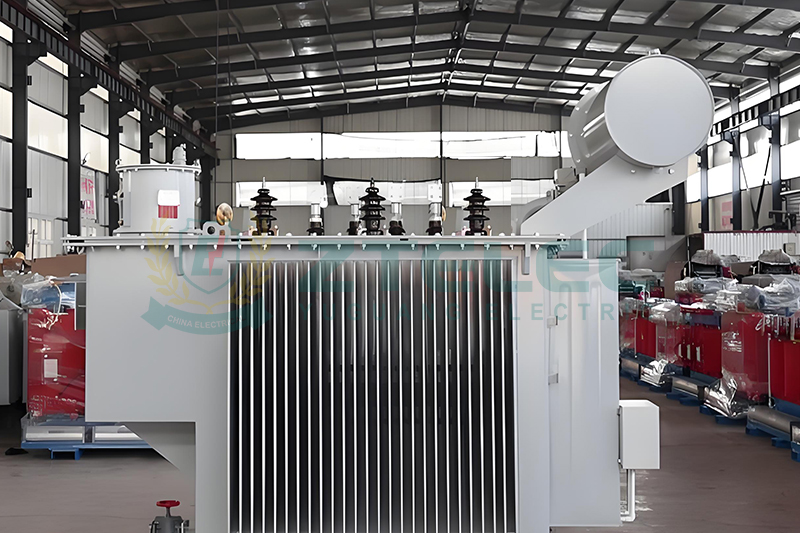
Oil immersed transformers deliver outstanding heat dissipation performance, yet stricter fire regulations apply due to mineral insulating oil filled inside the unit.
Indoor installation within commercial buildings normally requires dedicated fire-rated transformer rooms, fire partition walls, oil collection pits, oil drainage piping and automatic fire extinguishing devices. The cost of these auxiliary facilities often far exceeds the price gap between the two transformer types.
As a result, additional fire protection investment becomes a key factor impacting total project cost for indoor building installations.
Comparison of Installation Environment & Space Adaptability
| Item | Cast Resin Type | Oil Immersed Type |
|---|---|---|
| Installation Location | Floor electrical rooms, basements | Outdoor areas or dedicated transformer buildings |
| Installation Flexibility | High | Average |
| Ingress Protection Rating | IP23~IP33 | IP44~IP54 |
| Humidity Resistance | Moisture-proof treatment mandatory | Innate good moisture resistance |
| Required Maintenance Clearance | Small | Large |
For coastal regions and high-humidity environments, special attention shall be paid to moisture-proof craftsmanship of dry transformer coils, such as vacuum casting, end sealing and special insulation treatment, to guarantee long-term operational reliability.
Energy Efficiency & Operational Loss Analysis
In accordance with GB 20052-2020
| Technical Parameter | Cast Resin (Grade 2 Efficiency) | Oil Immersed (Grade 2 Efficiency) |
|---|---|---|
| No-Load Loss | 480~530 W | 420~480 W |
| Load Loss | 3500~3800 W | 3500~4000 W |
| No-Load Current | ≤1.0% | ≤0.8% |
| Short-Term Overload Capacity | Approx. 120% | 140%~160% |
Based on 8,760 annual operating hours and average 60% load factor, the annual electricity cost difference between the two types is usually less than 500 RMB, so operational loss is not a core decision-making factor for commercial building projects.
Procurement Cost & Total Cost of Ownership (TCO)
Many purchasers only focus on equipment quotations while ignoring auxiliary installation and long-term maintenance expenses. In reality, commercial building transformers shall be comprehensively evaluated via Total Cost of Ownership (TCO).
| Cost Item | Cast Resin Type | Oil Immersed Type |
|---|---|---|
| Equipment Purchase Price (FOB China) | USD 8,000~12,000 | USD 5,000~8,000 |
| Fire Protection Civil Engineering Investment | Nearly zero extra cost | USD 8,000~20,000 |
| Fire Suppression System Investment | No dedicated setup required | USD 3,000~10,000 |
| Annual Maintenance Expense | USD 200~400 | USD 600~1,200 |
| Design Service Life | 25~30 years | 30~40 years |
Although oil immersed transformers carry lower upfront equipment cost, their fire protection and civil engineering auxiliary expenses far exceed the price gap for indoor commercial building installations. Therefore, the 20-year comprehensive TCO is generally very close to cast resin solutions, and cast resin alternatives are even more economical in certain projects.
Recommended Solutions for Different Types of Commercial Buildings
High-Rise Office Buildings
Cast resin dry type transformers are recommended. Boasting superior fire performance, they can be directly installed in floor electrical rooms with minimal follow-up maintenance workload, perfectly fitting property management demands.
Commercial Complexes & Shopping Malls
Cast resin units are the priority choice, effectively simplifying fire approval procedures and upgrading building safety standards.
Hospitals, Data Centers & Rail Transit Facilities
Cast resin transformers are advised. Zero oil leakage risk, high reliability and low noise satisfy continuous power supply requirements.
Industrial Parks & Logistics Warehouses
If independent outdoor substations are available, oil immersed transformers deliver higher cost performance and stronger overload capacity.
Compact Prefabricated Substations
Oil immersed transformers normally hold economic advantages, especially for outdoor installation scenarios.
Key Technical Documents to Request When Purchasing 315 kVA Transformers
Buyers shall require manufacturers to supply complete technical documentation including type test reports, routine test reports, short-circuit withstand tests, temperature rise tests, noise test certificates, energy efficiency inspection reports, fire resistance grade certificates (F1/F0), test reports issued by CNAS-accredited laboratories, IEC 60076 series test records and product quality guarantees. For export projects, verify compliance with IEC, ANSI or local grid standards.
Frequently Asked Questions (FAQ)
Are oil immersed transformers suitable for installation in commercial building basements?
Installation is permissible, yet full compliance with fire codes is mandatory, including dedicated fire-rated transformer rooms, oil collection pits, oil drainage piping and fire suppression equipment, leading to high overall investment costs.
Why do an increasing number of commercial buildings adopt cast resin transformers?
The primary drivers include superior fire safety grade, oil-free design, flexible installation, easy maintenance, better environmental performance and reduced complexity of building fire protection design.
Is there a significant gap in operating costs between the two 315 kVA transformer types?
The difference is negligible. Even under full-year continuous operation, the electricity cost variance rarely exceeds 500 RMB, exerting minimal impact on overall project investment.
Do oil immersed transformers offer longer service life?
With proper maintenance, oil immersed transformers have a design lifespan of 30–40 years; cast resin transformers can operate stably for 25–30 years, fully meeting the lifecycle requirements of most commercial buildings.
For indoor installation projects including office towers, commercial complexes, hospitals, schools and data centers, cast resin dry type transformers stand as the optimal choice thanks to excellent fire resistance, maintenance-free features and lower comprehensive construction costs.
For industrial parks, logistics hubs, standalone substations and outdoor compact prefabricated substation projects, oil immersed transformers retain clear strengths via lower procurement prices, enhanced heat dissipation and greater overload capacity.
During actual procurement, avoid comparing equipment prices in isolation. Evaluate fire regulations, installation conditions, operational efficiency, maintenance expenses and Total Cost of Ownership (TCO) holistically to select the most suitable 315 kVA transformer solution matching your project demands.
315 kVA transformer
Cast resin transformer
315kVA oil immersed transformer
315kVA dry type transformer
OEM transformer manufacturer
- more+releated article
- 2026-06-26315 kVA Transformers for Commercial Buildings:
- 2026-06-25China Transformer OEM Manufacturing Services a
- 2026-06-241500 kVA Oil Immersed Transformer for Substati
- 2026-06-24Successful Opening Day at CWIEME Shanghai 2026
- 2026-06-23Mineral Oil vs Biodegradable Ester Fluids in T
- 2026-06-22How to Write a 1250 kVA Cast Resin Transformer
- 2026-06-18ZTELECGROUP Mid-Year Sale 2026: Full Range Dis
- 2026-06-1811kV Compact Substations for Commercial Buildi
- 2026-06-17500 kVA Oil Immersed Transformer Selection &am
- 2026-06-16Oil Immersed Transformer Maintenance Guide: In
- ELECTRICAL INSULATION BOARD MATERIALS
- ELECTRICAL INSULATION MATERIALS
- POWER TRANSFORMER
- ENAMELED WIRE
- SWITCHGEAR


Cast resin transformer
315kVA oil immersed transformer
315kVA dry type transformer
315 kVA transformer
OEM transformer manufacturer
transformer private label manufacturing
China transformer OEM
transformer OEM supplier China
ZTELEC GROUP Xujue Electrical Debuts at Booth 1N21
CWIEME Shanghai 2026
1500 kVA oil immersed transformer
transformer specification checklist
substation transformer
FR3 insulating fluid
natural ester transformer
mineral oil transformer
synthetic ester transformer
dry type transformer specification
1250 kVA cast resin transformer RFQ
transformer procurement guide
IEC 60076-11 transformer
11kV prefabricated substation
European type substation
prefabricated substation
11kV compact substation