
Common Uses of Filament Wound Fiberglass Tubing
In power equipment, motors, and new energy systems, the reliability of insulation materials has a significant impact on the safe operation and service life of the equipment. Filament wound fiberglass tubing possesses excellent electrical insulation properties, high mechanical strength, and good weather resistance, thus they are widely used in various electrical and industrial equipment.
What is Filament Wound Fiberglass Tubing?
Filament wound fiberglass tubing is a composite material tube. Its production process involves impregnating continuous glass fibers with epoxy resin, winding them at a specific angle onto a mandrel, and then curing them.
Compared to fiberglass tubes produced by ordinary pultrusion or molding processes, filament wound fiberglass tubing has a more uniform fiber distribution, a denser structure, and more stable performance.
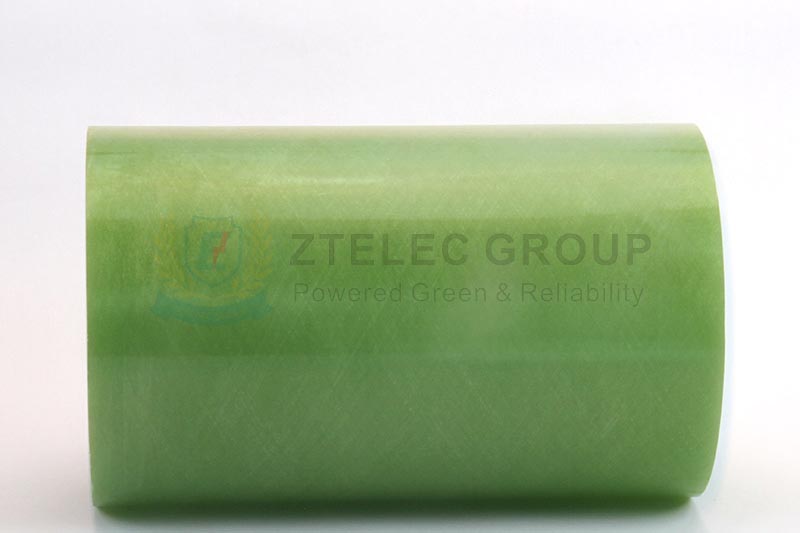
Key Features of Filament Wound Fiberglass Tubing
Good Electrical Insulation: Suitable for medium and high voltage environments
High Heat Resistance: Standard heat resistance grades are F or H
High Mechanical Strength: Provides both insulation and structural support
Moisture and Corrosion Resistance: Suitable for various complex environments
Customizable Sizes: Inner diameter, wall thickness, etc., can be adjusted as needed
Based on these features, filament wound fiberglass tubing can be used not only as insulating components but also as structural parts in electrical equipment.
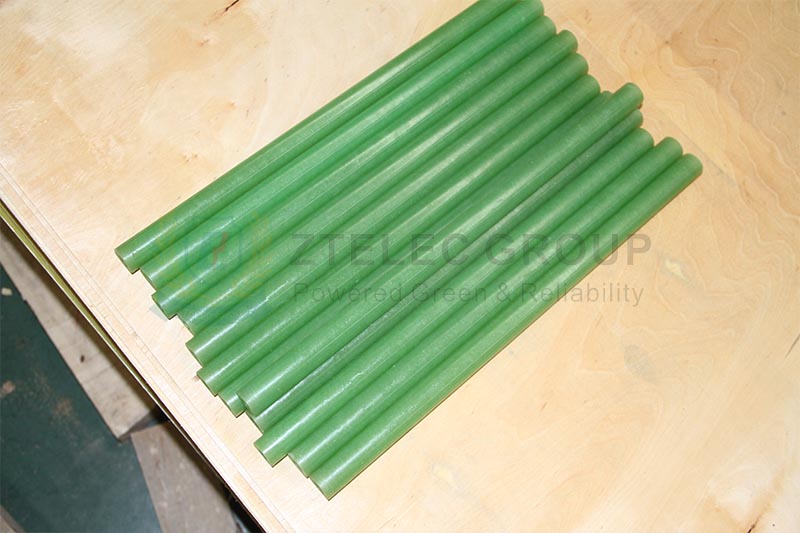
Common Applications of Filament Wound Fiberglass Tubing
1. Transformer Insulation and Support
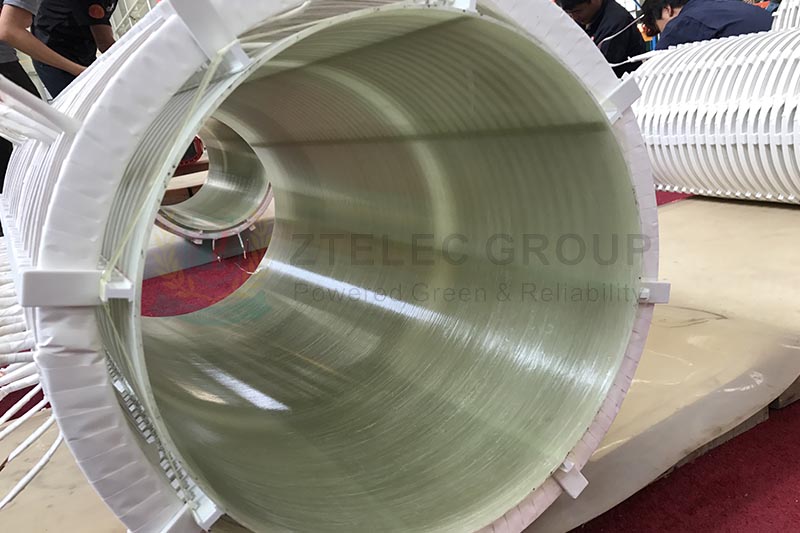
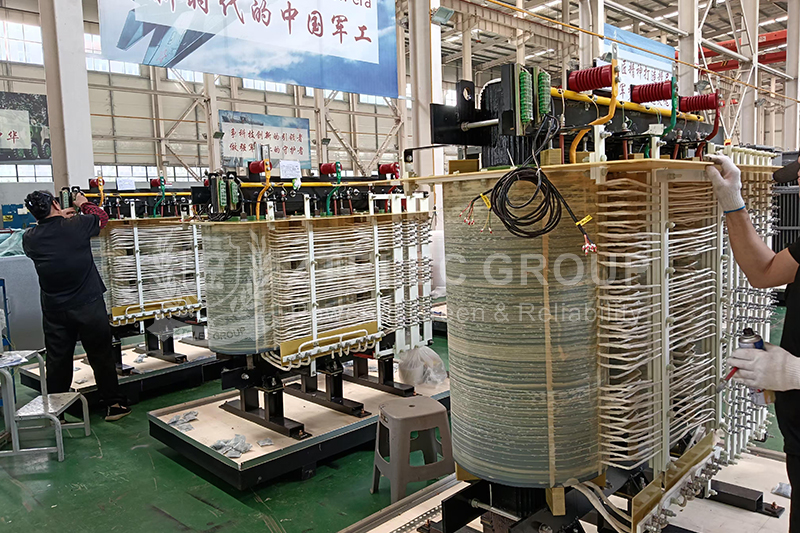
In oil-immersed and dry-type transformers, filament wound fiberglass tubing is commonly used for:
Winding insulation bushings
Tie rods and support columns
Phase-to-phase insulation components
Their good mechanical strength and electrical properties help improve the stability and short-circuit withstand capability of transformer operation.
2. Motor and Generator Insulation Components
In medium and large-sized motors and generators, filament wound fiberglass tubing is mostly used for:
Stator or rotor insulation supports
High-strength insulation sleeves
Axial insulation components
It maintains stable performance even under high-speed and high-temperature operating conditions.
3. High-Voltage Switchgear and Distribution Systems
In high-voltage and medium-voltage switchgear, common applications of filament wound fiberglass tubing include:
Insulating supports
Insulating isolation sleeves
Structural insulation supports
This material is suitable for applications requiring high mechanical strength and insulation distance.
4. New Energy and Power Electronic Equipment
In photovoltaic, wind power, energy storage, and rectifier systems, filament wound fiberglass tubing can be used for:
DC system insulation support
Rectifier transformer insulation structures
High-temperature power electronic equipment insulation components.
Their environmental resistance helps improve the long-term operational reliability of the system.
5. Insulation Applications in Industrial Equipment and Special Environments
In chemical, rail transportation, and mining industries, filament wound fiberglass tubing is commonly used as:
Insulating protective tubing
Structurally reinforced insulation components
Moisture-proof and corrosion-resistant insulation assemblies
Factors to Consider When Selecting Filament Wound Fiberglass Tubing
When selecting filament wound fiberglass tubing based on specific application conditions, the following aspects should be carefully evaluated:
Temperature resistance: Select a suitable resin system (e.g., epoxy, phenolic, polyester, etc.) based on the operating temperature.
Electrical properties: Dielectric strength, volume resistivity, and surface resistivity should meet the applicable standards.
Mechanical properties: Tensile strength, flexural strength, and compressive strength must meet structural requirements.
Chemical resistance: Resistance to the chemical media encountered.
Dimensional accuracy: Tolerances for inner diameter, outer diameter, and wall thickness are crucial for assembly.
Certification requirements: Compliance with relevant industry certifications (e.g., UL, CSA, RoHS, etc.)
As a mature composite insulation material, filament wound fiberglass tubing is widely used in power, motor, and new energy fields. It combines electrical insulation and structural support functions, providing a safe and stable solution for electrical equipment.
Get a customized solution: Choose the right filament wound fiberglass tubing for your project.
If you are looking for insulation materials for a specific project or need to determine the appropriate filament wound fiberglass tubing specifications, we can provide professional consultation and product quotations to support the smooth implementation of your project.
oil immersed transformer lifespan
oil immersed transformer maintenance
transformer lifecycle
transformer insulation aging
dry type transformer temperature monitoring
- more+releated article
- 2026-05-11How Long Does an Oil-Immersed Transformer Last
- 2026-05-08Modern Power System Dry-Type Transformer Insta
- 2026-05-07Oil-Immersed Transformer Overheating: Causes,
- 2026-05-07Dry-Type Transformers for Data Centers: 2026 R
- 2026-04-30Air-Core Reactor vs Iron-Core Reactor: How to
- 2026-04-29Compact Enclosed Transformer for Smart Grid: T
- 2026-04-2812-Pulse and 24-Pulse Phase-Shifting Transform
- 2026-04-27Oil-Immersed Transformers for Industrial Plant
- 2026-04-25Why Dry-Type Transformers Are Preferred for Ho
- 2026-04-24Enclosed Transformer Outdoor Solutions: IP Pro
- ELECTRICAL INSULATION BOARD MATERIALS
- ELECTRICAL INSULATION MATERIALS
- POWER TRANSFORMER
- ENAMELED WIRE
- SWITCHGEAR


transformer insulation aging
transformer lifecycle
oil immersed transformer lifespan
oil immersed transformer maintenance
dry type transformer installation
dry type transformer temperature monitoring
dry type transformer maintenance
dry type transformer sizing
transformer cooling system failure
transformer overheating causes
oil immersed transformer overheating
transformer oil temperature
harmonic mitigation
dry type transformer
K factor transformer
data center transformer
Cast resin transformer
insulation oil degradation
DGA analysis transformer
transformer fault analysis
oil immersed transformer failure
smart grid transformer
compact enclosed transformer
integrated distribution transformer
compact transformer substation