
How to Select Power Transformers for High-Rise Buildings: Capacity, Safety, and Standards
In modern urban construction projects, high-rise buildings place significantly higher demands on power supply systems than low-rise or conventional buildings. Power transformers serve as the core equipment responsible for voltage transformation, load distribution, and system stability throughout the entire building. Selecting the right power transformer is therefore a critical step in ensuring reliable operation, safety compliance, and long-term energy efficiency.
Compared with ordinary buildings, high-rise residential buildings, office towers, and large commercial complexes require careful consideration of transformer capacity configuration, fire and electrical safety, space limitations, and compliance with national and international standards. This article provides a systematic guide to selecting power transformers for high-rise buildings, focusing on capacity calculation, safety design, and applicable standards.

Power Load Characteristics of High-Rise Buildings
The electrical load characteristics of high-rise buildings differ significantly from those of conventional structures. Power demand is highly concentrated, and the total installed capacity is relatively large due to the vertical distribution of loads.
High-rise buildings typically have a high proportion of critical loads, including elevators, fire protection systems, HVAC equipment, water supply and drainage systems, and emergency lighting. These loads require uninterrupted power supply and stable voltage conditions.
In addition, distribution rooms and transformer rooms in high-rise buildings are often limited in space. Equipment size, noise level, heat dissipation, and installation layout are subject to strict architectural constraints. Based on these characteristics, transformer selection must consider not only capacity calculation but also system reliability, safety, and operational stability.
Capacity Selection of Power Transformers for High-Rise Buildings
Principles of Load Calculation
The rated capacity of a power transformer should be determined through comprehensive load calculation rather than simple estimation. Key factors include the total installed electrical capacity of the building, simultaneity and demand factors, power factor correction values, and a reasonable margin for future expansion.
In most high-rise building projects, a future expansion margin of approximately 10 to 20 percent is recommended. To improve power supply reliability and simplify maintenance, two or more transformers are often configured to operate in parallel.
Recommended Capacity Configuration
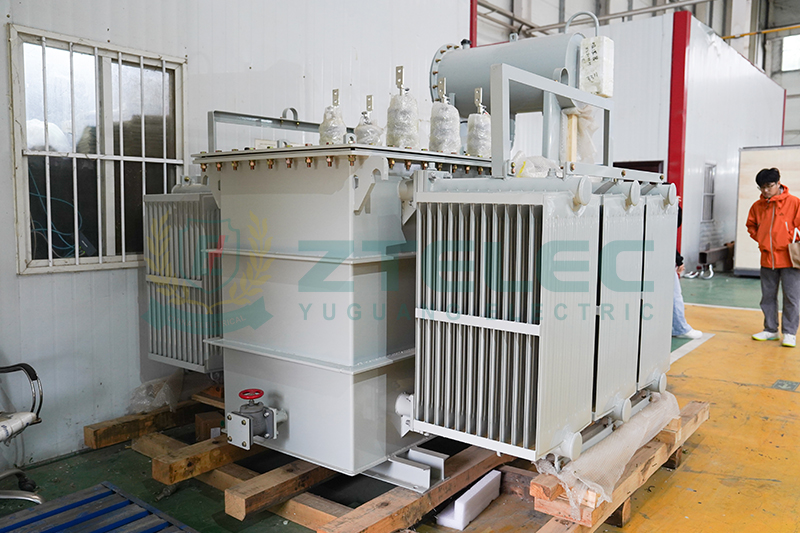
For single high-rise residential buildings, transformers with rated capacities ranging from 800 kVA to 2500 kVA are commonly applied. Commercial complexes and office buildings usually require transformer capacities between 2500 kVA and 10000 kVA or higher, depending on the scale and function of the building.
Super high-rise buildings typically adopt a zoned power supply strategy, using multiple medium- and large-capacity transformers to serve different functional areas and vertical zones. This approach enhances system flexibility and improves fault isolation.
If the selected transformer capacity is too small, equipment overload may occur, leading to accelerated insulation aging and reduced service life. Conversely, oversized transformers increase initial investment and no-load losses. Therefore, transformer capacity should match the actual load demand as closely as possible.
Safety Considerations for Power Transformers in High-Rise Buildings
Fire Safety Design
Fire safety is a primary concern in high-rise buildings. Dry-type transformers are generally preferred due to their fire-resistant characteristics and the absence of insulating oil, which eliminates oil-related fire risks.
Transformer rooms should be constructed with fire-resistant walls rated for no less than two hours, and Class A fire doors should be installed. In addition, gas-based fire extinguishing systems are commonly required to ensure rapid fire suppression without damaging electrical equipment.
Electrical Safety and Protection
A complete relay protection system is essential for transformer operation in high-rise buildings. This includes overcurrent protection, overload protection, temperature monitoring, and differential protection to prevent electrical faults from spreading.
The grounding system must comply with the building’s overall grounding design requirements to ensure reliable earthing. Transformer selection and layout should also be coordinated with the building’s lightning protection system.
Environmental and Heat Dissipation Requirements
Transformer rooms must provide sufficient ventilation to ensure effective heat dissipation during continuous operation. Low-noise transformers are recommended to minimize the impact on office and residential environments.
For underground or basement transformer rooms, effective waterproofing and moisture protection measures are critical to maintaining long-term operational reliability.
Standards and Certifications for Power Transformers in High-Rise Buildings
Power transformers used in high-rise buildings must comply with relevant national and international standards to ensure safety, performance, and regulatory acceptance.
Commonly applied standards include IEC 60076 for power transformers, GB/T 6451 and GB 1094 for Chinese national standards, and IEEE C57 standards for North American projects. During project planning and procurement, the applicable standard system should be clearly defined.
Energy efficiency requirements are also increasingly important. Transformer efficiency ratings should comply with local energy efficiency standards, such as China’s GB 20052. For applications with low load rates, transformers with low no-load losses are preferred, while transformers with optimized load losses should be selected based on actual operating conditions.
From a certification perspective, manufacturers are typically required to hold ISO 9001 quality management certification and ISO 14001 environmental management certification. Export-oriented projects may also require CE, TUV, or UL certification.
Practical Recommendations for Transformer Procurement
When selecting power transformers for high-rise buildings, decision-makers should focus on total life-cycle cost rather than initial purchase price alone. Long-term efficiency, reliability, maintenance requirements, and service support all affect overall project value.
It is recommended to prioritize manufacturers with proven experience in supplying high-rise building projects. Type test reports and routine factory test reports should be requested to verify product performance.
Technical parameters, applicable standards, inspection requirements, and warranty terms should be clearly specified in contracts to avoid disputes during project execution. Future capacity expansion should also be considered in advance to ensure system compatibility.
Selecting the right power transformer is a key factor in ensuring the safe, reliable, and efficient operation of high-rise buildings. By carefully evaluating capacity requirements, safety design, and standard compliance, project owners and engineers can build power systems that support long-term urban development.
If you are planning or upgrading a high-rise building power system, professional transformer selection and technical support can help optimize performance and reduce risk.
We provide dry-type and oil-immersed power transformers compliant with IEC, GB, IEEE, and other international standards. Our team offers selection guidance, technical parameter confirmation, customized solutions, and after-sales service for high-rise building projects worldwide. Contact us for a professional quotation and technical consultation.
oil immersed transformer lifespan
oil immersed transformer maintenance
transformer lifecycle
transformer insulation aging
dry type transformer temperature monitoring
- more+releated article
- 2026-05-11How Long Does an Oil-Immersed Transformer Last
- 2026-05-08Modern Power System Dry-Type Transformer Insta
- 2026-05-07Oil-Immersed Transformer Overheating: Causes,
- 2026-05-07Dry-Type Transformers for Data Centers: 2026 R
- 2026-04-30Air-Core Reactor vs Iron-Core Reactor: How to
- 2026-04-29Compact Enclosed Transformer for Smart Grid: T
- 2026-04-2812-Pulse and 24-Pulse Phase-Shifting Transform
- 2026-04-27Oil-Immersed Transformers for Industrial Plant
- 2026-04-25Why Dry-Type Transformers Are Preferred for Ho
- 2026-04-24Enclosed Transformer Outdoor Solutions: IP Pro
- ELECTRICAL INSULATION BOARD MATERIALS
- ELECTRICAL INSULATION MATERIALS
- POWER TRANSFORMER
- ENAMELED WIRE
- SWITCHGEAR



transformer insulation aging
transformer lifecycle
oil immersed transformer lifespan
oil immersed transformer maintenance
dry type transformer installation
dry type transformer temperature monitoring
dry type transformer maintenance
dry type transformer sizing
transformer cooling system failure
transformer overheating causes
oil immersed transformer overheating
transformer oil temperature
harmonic mitigation
dry type transformer
K factor transformer
data center transformer
Cast resin transformer
insulation oil degradation
DGA analysis transformer
transformer fault analysis
oil immersed transformer failure
smart grid transformer
compact enclosed transformer
integrated distribution transformer
compact transformer substation