
Data Center Substations vs Industrial Substations: Key Differences in Equipment Selection
With the rapid growth of cloud computing, artificial intelligence, and digital infrastructure, the scale of data center construction continues to expand worldwide. At the same time, traditional industrial sectors are demanding higher standards for power system reliability and operational efficiency. Although both data center substations and industrial substations belong to medium- and high-voltage power distribution systems, they differ fundamentally in load characteristics, operational philosophy, equipment configuration, and reliability requirements.
Many projects make the mistake of directly applying traditional industrial substation design concepts to data center facilities. This often leads to reduced energy efficiency, increased maintenance complexity, and even serious power supply risks. In reality, data center substations are designed around the concept of uninterrupted operation, while industrial substations focus more on economic performance, equipment durability, and handling impact loads.
This article provides a comprehensive comparison between data center substations and industrial substations, covering transformers, UPS systems, switchgear, redundancy architecture, power quality equipment, and intelligent monitoring systems. It is intended to help engineers, EPC contractors, and procurement decision-makers establish more effective electrical infrastructure strategies.
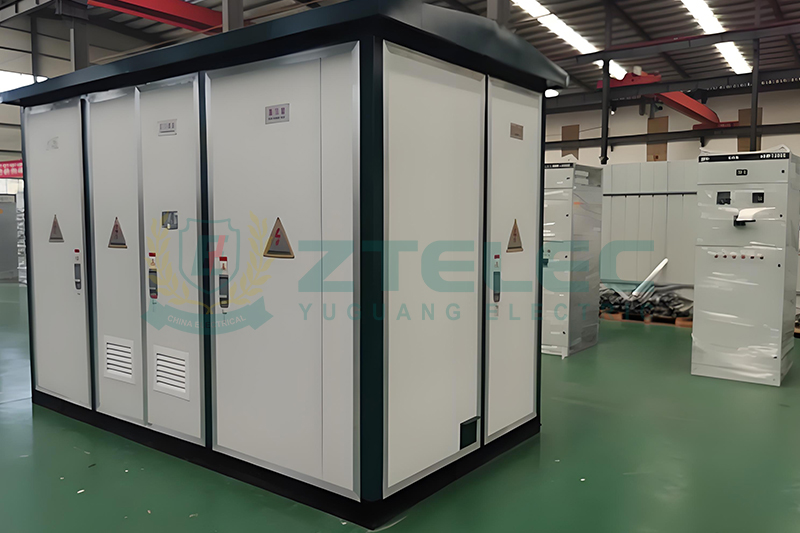
Why Data Centers and Industrial Substations Cannot Share the Same Design Logic
Industrial substations primarily serve production lines, motor drives, heating systems, compressors, and heavy industrial equipment. Most industrial facilities allow scheduled shutdowns for maintenance, repairs, or production adjustments, so their power systems prioritize cost control and equipment utilization.
Data centers operate under completely different conditions. Servers, storage systems, network switches, and communication equipment require continuous 24/7 operation. Even a brief voltage sag, frequency fluctuation, or millisecond-level interruption can result in server crashes, database corruption, or critical business downtime.
As a result, the core objective of a data center substation is not merely power delivery but uninterrupted power continuity. This leads to major differences in transformer selection, UPS architecture, switchgear response speed, and intelligent monitoring requirements.
Transformer Selection: Harmonic Tolerance vs Overload Capability
Key Requirements for Data Center Transformers
IT equipment in data centers relies heavily on switch-mode power supplies (SMPS), which are typical nonlinear loads that generate significant 3rd, 5th, and 7th harmonics. These harmonics increase transformer iron losses and copper losses, leading to higher operating temperatures. Therefore, data centers commonly use low-loss K-rated transformers designed for harmonic-rich environments.
Most data center transformers require K13 to K20 ratings to withstand continuous harmonic currents. To optimize PUE (Power Usage Effectiveness), transformers are generally operated within a 40% to 70% load range rather than near full load conditions.
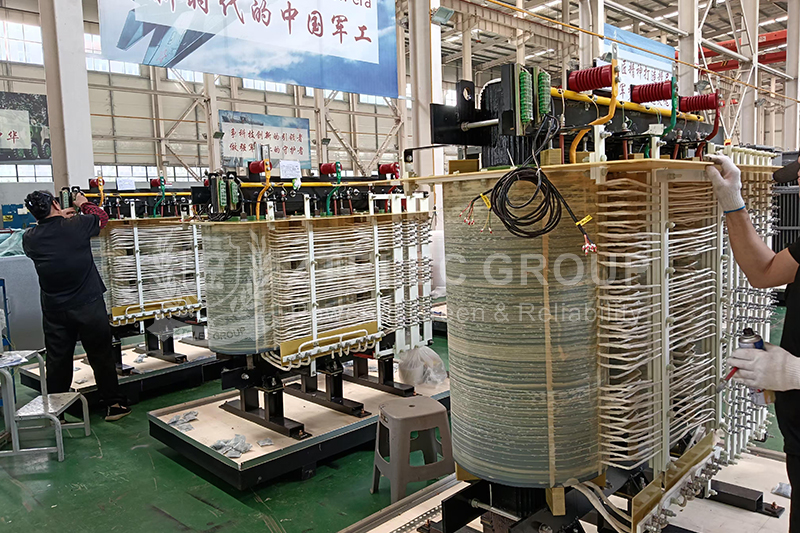
In addition, epoxy resin cast dry-type transformers are widely preferred inside data center buildings because they are oil-free, fire-resistant, leak-proof, and suitable for enclosed indoor environments.
Transformer Logic in Industrial Substations
Industrial facilities mainly operate motors, compressors, furnaces, and heating systems, which are primarily inductive or resistive loads with relatively simpler harmonic conditions. Therefore, industrial substations place greater emphasis on overload capability, operational economy, and lifecycle cost.
Oil-immersed transformers remain the dominant solution in industrial applications due to their strong cooling performance, lower initial cost, and excellent short-term overload capability. Large motor starting currents often require transformers capable of handling 120% to 150% temporary overload conditions.
Compared with data centers, industrial substations focus more on achieving optimal efficiency within a 70% to 85% loading range rather than minimizing no-load losses.
Switchgear Differences: Millisecond Switching vs Mechanical Durability
High-Speed Switching in Data Centers
Power continuity is one of the most critical metrics in data center operation. Therefore, switchgear systems must provide not only high reliability but also extremely fast fault transfer capability.
Static Transfer Switches (STS) are among the most representative devices in data center power systems. When one power source fails, the STS can transfer loads to an alternate source within 4 milliseconds, preventing server shutdowns. Such devices are rarely used in traditional industrial substations.
Modern data centers also widely adopt intelligent Air Circuit Breakers (ACB) with integrated communication protocols such as Modbus and SNMP, enabling remote monitoring, predictive maintenance, and smart operation management.
In dual-bus architectures, bus tie breakers are required to support automatic fast transfer functions, typically within 100 milliseconds, ensuring uninterrupted power supply to critical loads.
Industrial Switchgear Prioritizes Breaking Capacity
Industrial switchgear systems focus more on high interrupting capacity and mechanical durability. Large motor starts, arc furnaces, and heavy-duty industrial loads generate substantial fault currents and electrical stress, requiring robust breaker performance.
Frequent switching operations in industrial environments also demand longer mechanical life cycles. In many factories, stricter ground fault protection is required to ensure personnel safety and equipment reliability.
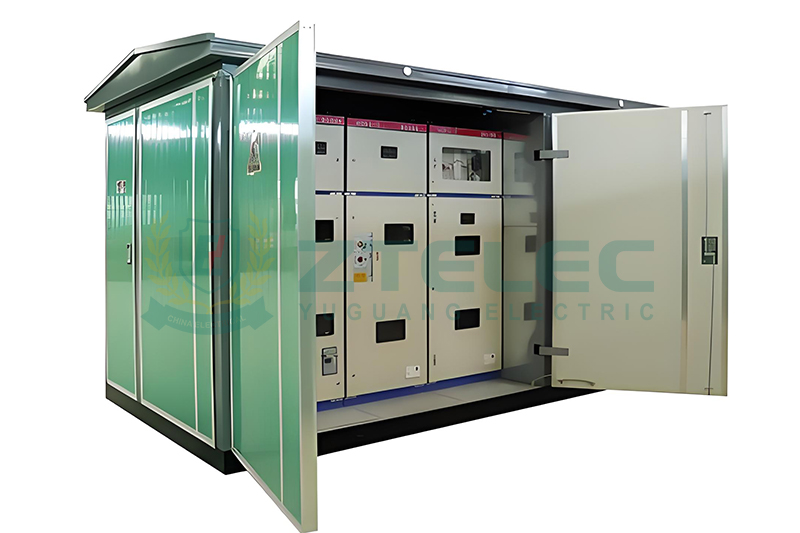
UPS Systems: Core Infrastructure for Data Centers, Auxiliary Support for Industry
The Critical Role of UPS in Data Centers
UPS systems are among the most important components of a data center power infrastructure. During utility failures, voltage disturbances, or generator transfer events, the UPS maintains continuous power supply to IT equipment.
Modern data centers commonly deploy modular UPS systems with hot-swappable power modules and scalable capacities ranging from 25kW to several megawatts. To eliminate single points of failure, Tier III and Tier IV facilities often use dual A/B power paths with N+1, 2N, or even 2(N+1) redundancy configurations.
UPS efficiency is another major concern. High-end UPS systems are expected to achieve efficiencies above 97% in ECO mode to improve overall PUE performance.
Regarding energy storage, many large-scale data centers are replacing traditional lead-acid batteries with lithium iron phosphate (LiFePO4) battery systems because of their longer lifespan, smaller footprint, and reduced maintenance requirements.
UPS Systems in Industrial Substations
Industrial substations also use UPS systems, but mainly for control systems, PLCs, protection relays, and instrumentation rather than supporting the entire production process.
As a result, industrial UPS capacities are generally small, often below 10kVA, with much lower requirements for redundancy and energy efficiency compared to data centers.
Redundancy Architecture: Tier Standards Define System Complexity
One of the biggest differences between data center substations and industrial substations lies in redundancy philosophy.
Industrial substations typically adopt N or N+1 configurations, allowing scheduled maintenance downtime. In contrast, Tier III and Tier IV data centers require fully independent dual power paths and highly redundant infrastructure.
A 2N architecture means the entire power system is fully duplicated, while 2(N+1) adds additional backup redundancy for hyperscale cloud, financial, and mission-critical data center applications.
Although higher redundancy levels significantly improve system availability, they also increase capital investment, floor space requirements, and operational complexity. Therefore, redundancy strategy must be carefully aligned with business continuity goals and project budgets.
Power Quality Management: A Mandatory Requirement for Data Centers
Data centers contain large volumes of nonlinear IT loads, making harmonic distortion, voltage fluctuations, and reactive power issues more severe. As a result, power quality management has become a standard requirement in modern data center design.
Active Power Filters (APF) dynamically suppress harmonic currents, reducing transformer overheating and preventing protection system malfunctions. Static Var Generators (SVG) provide millisecond-level reactive power compensation to stabilize bus voltage.
High-level data centers also deploy real-time power quality monitoring systems that continuously track Total Harmonic Distortion (THD), voltage imbalance, and frequency deviation around the clock.
Industrial substations, by comparison, often rely on conventional capacitor banks for power factor correction, resulting in much lower overall power quality management costs.
Monitoring Systems: DCIM vs SCADA
Data center substations typically use DCIM (Data Center Infrastructure Management) platforms to integrate power distribution, cooling systems, IT assets, and energy management into a unified monitoring environment.
DCIM platforms focus not only on equipment status but also on capacity forecasting, energy optimization, and asset utilization. Even individual PDUs and rack-level loads are often monitored in real time.
Industrial substations generally use SCADA (Supervisory Control and Data Acquisition) systems, which are more focused on process control, remote operation, and protection coordination.
The main distinction lies in monitoring granularity. Data centers require highly detailed energy visibility, while industrial systems emphasize operational stability and control efficiency.
Summary of Key Differences Between Data Center and Industrial Substations
Overall, data center substations prioritize uninterrupted operation, low-loss efficiency, and intelligent management, while industrial substations emphasize economic operation, equipment durability, and the ability to handle heavy impact loads.
Data centers commonly use K-rated dry-type transformers, high-redundancy UPS systems, STS transfer technology, and APF+SVG dynamic power quality solutions. Industrial substations more frequently rely on oil-immersed transformers, standard N+1 configurations, and conventional reactive power compensation systems.
These differences ultimately reflect two fundamentally different operational philosophies: data centers are designed for “zero interruption,” while industrial facilities are designed around “planned downtime.”
As digital infrastructure and intelligent manufacturing continue to expand globally, more engineering teams are now involved in both data center and industrial projects. Understanding the fundamental differences in equipment selection and system architecture is essential for reducing project risks, optimizing investment costs, and ensuring long-term power reliability.
In real-world applications, engineers should first define load characteristics, business continuity requirements, Tier classification, and future expansion plans before selecting electrical infrastructure solutions. A properly engineered power distribution system not only improves operational reliability but also prevents costly overdesign and unnecessary capital expenditure.
industrial substation
data center substation
dry type transformer
data center UPS
Oil immersed transformer
- more+releated article
- 2026-05-21Data Center Substations vs Industrial Substati
- 2026-05-2066kV vs 110kV Oil Immersed Transformers: Which
- 2026-05-19CWIEME Berlin 2026 · Day 1 Exhibition Report
- 2026-05-19Cast Resin vs VPI Dry-Type Transformers: Key D
- 2026-05-18Oil-Immersed Transformer vs Dry-Type Transform
- 2026-05-15Dry-Type Transformer Energy Efficiency Standar
- 2026-05-142026 Dry-Type Transformer Price Factors: Capac
- 2026-05-13What Is an Oil-Immersed Transformer? Working P
- 2026-05-13Medium Voltage Dry-Type Transformers in Solar
- 2026-05-11How Long Does an Oil-Immersed Transformer Last
- ELECTRICAL INSULATION BOARD MATERIALS
- ELECTRICAL INSULATION MATERIALS
- POWER TRANSFORMER
- ENAMELED WIRE
- SWITCHGEAR



data center substation
dry type transformer
data center UPS
industrial substation
Oil immersed transformer
custom transformer manufacturer
66kV oil immersed transformer
IEC 60076 certified transformer
VPI Dry-Type Transformer
Cast resin transformer
Vacuum Pressure Impregnation Transformer
dry-type transformer selection
transformer selection
oil immersed vs dry type transformer
dry-type transformer energy efficiency standards
IEC transformer standard
ANSI transformer efficiency
SCB11 transformer
2026 dry-type transformer
dry-type transformer price
dry-type transformer capacity
distribution transformer
oil filled transformer
Power transformer
solar transformer