
What Is an Oil-Immersed Transformer? Working Principle, Types and Main Applications
Oil-immersed transformers are among the most widely used core devices in modern power transmission and distribution systems. From large power plants to urban substations, from industrial manufacturing facilities to renewable energy projects, oil-immersed transformers play a critical role throughout the entire electrical energy chain. Thanks to their excellent insulation performance, reliable cooling capability, and long-term operational stability, they remain the preferred solution for high-voltage and large-capacity power applications.
This article provides a comprehensive overview of oil-immersed transformers, including their definition, working principle, cooling methods, classifications, applications, and maintenance practices, helping engineers, procurement professionals, and industry users gain a complete understanding of this essential electrical equipment.
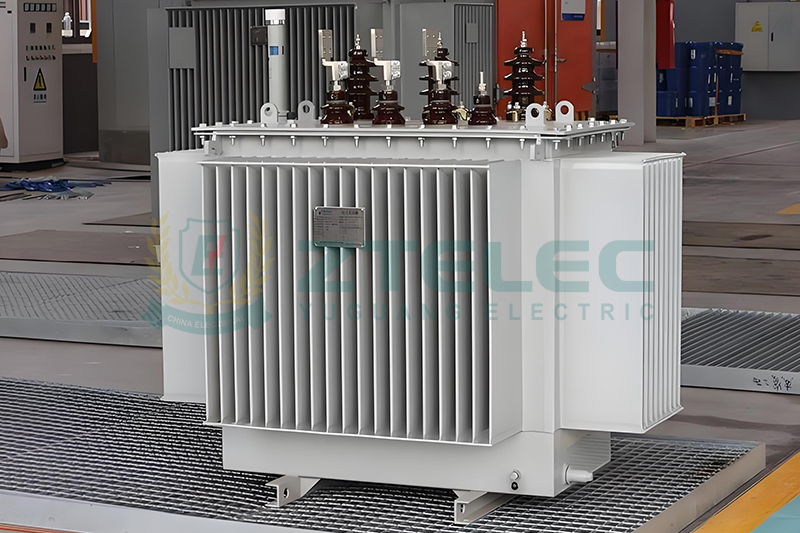
What Is an Oil-Immersed Transformer?
An oil-immersed transformer, also known as an oil-filled transformer, is a transformer in which the core and windings are fully submerged in insulating oil. The insulating liquid is typically high-purity mineral oil or natural ester fluid, serving multiple critical functions including electrical insulation, heat dissipation, and moisture protection.
Compared with dry-type transformers, oil-immersed transformers provide higher insulation strength and superior cooling performance, making them especially suitable for high-capacity and high-voltage applications. Their rated capacity can range from tens of kVA to hundreds of MVA, while voltage levels may reach 750kV and beyond.
In AC power systems, the primary function of a transformer is to change voltage levels for power transmission and distribution. Oil-immersed transformers dissipate heat generated by the core and windings through oil circulation, ensuring stable long-term operation. Under proper maintenance conditions, their service life typically ranges from 20 to 40 years.
Working Principle of Oil-Immersed Transformers
The operating principle of an oil-immersed transformer is based on electromagnetic induction. When alternating current flows through the primary winding, it creates an alternating magnetic flux inside the core. This magnetic flux passes through the secondary winding and induces an output voltage. By adjusting the turns ratio between the primary and secondary windings, the transformer can step voltage up or down.
The entire energy conversion process involves AC power input, electromagnetic coupling, magnetic flux transfer, and output voltage generation. The core provides the magnetic path, the windings perform energy conversion, and the insulating oil handles insulation and cooling functions.
Key Functions of Transformer Oil
Transformer oil is one of the most important internal media in an oil-immersed transformer. Its performance directly affects equipment safety, reliability, and service life.
For electrical insulation, transformer oil provides high dielectric strength, effectively isolating high-voltage windings and reducing the risk of electrical breakdown or discharge.
For cooling, the insulating oil transfers heat generated by the windings and core to the tank walls and radiators through natural or forced circulation.
For moisture protection, transformer oil isolates internal components from air and humidity, slowing insulation aging and improving long-term reliability.
Main Technical Parameters of Oil-Immersed Transformers
| Parameter | Typical Range | Description |
|---|---|---|
| Rated Capacity | 50kVA ~ 500MVA | Configured according to application requirements |
| Voltage Level | 6kV ~ 750kV | Suitable for distribution and transmission systems |
| No-Load Loss | 0.1% ~ 0.5% | Mainly caused by core magnetization |
| Load Loss | 0.3% ~ 1.2% | Mainly caused by winding copper losses |
| Oil Dielectric Strength | ≥30kV/2.5mm | Meets insulation safety standards |
| Design Life | 20 ~ 40 Years | Under proper maintenance conditions |
Main Types of Oil-Immersed Transformers
Oil-immersed transformers can be classified based on cooling methods, structural design, and application requirements. Understanding different transformer types helps optimize project selection and system performance.
Classification by Cooling Method
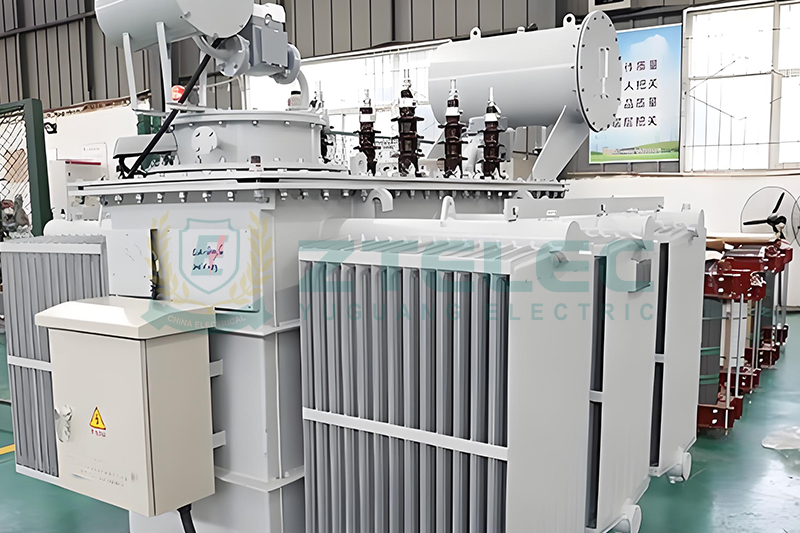
ONAN (Oil Natural Air Natural) transformers rely on natural oil circulation and natural air cooling. They feature a simple structure and stable operation, making them widely used in medium and small distribution systems.
ONAF (Oil Natural Air Forced) transformers add forced-air cooling fans to improve heat dissipation and overload capability, making them suitable for medium and large power transformers.
OFAF (Oil Forced Air Forced) transformers use oil pumps for forced oil circulation combined with forced-air cooling systems, significantly improving cooling efficiency for large transmission transformers.
OFWF (Oil Forced Water Forced) transformers replace air cooling with water cooling and are commonly used in large power plants, underground substations, and high-density energy facilities requiring higher cooling efficiency.
Classification by Application
Distribution transformers are mainly used to step down medium-voltage distribution power, such as 10kV or 35kV, to low-voltage 400V systems for industrial parks, commercial buildings, and residential power supply.
Step-up transformers are installed in power plants to increase generator output voltage to 110kV, 220kV, or higher before connecting to the transmission grid.
Step-down transformers are commonly used in substations to reduce extra-high transmission voltages to regional distribution levels.
Interconnection transformers connect power grids with different voltage levels, enabling cross-regional power transmission and dispatching.
Special-purpose transformers include rectifier transformers, traction transformers, furnace transformers, and testing transformers designed for specific industrial applications.
Main Applications of Oil-Immersed Transformers
Power Transmission and Distribution Systems
Power transmission and distribution networks represent the primary application area for oil-immersed transformers. Every stage of voltage conversion, from ultra-high-voltage transmission systems to urban distribution networks, depends on oil-filled transformers for reliable operation.
Industrial Manufacturing and Metallurgy
Industries such as steel production, metallurgy, non-ferrous metal processing, petrochemicals, and cement manufacturing require stable power supply for continuous heavy-load operation. Oil-immersed transformers are widely used due to their excellent overload capacity and cooling performance.
Railway and Urban Transit Systems
High-speed railways, metro systems, and urban transit networks use traction transformers to provide stable power for railway electrification systems. Rapid railway infrastructure development continues to drive demand for traction transformers worldwide.
Data Centers and Large Commercial Buildings
Large-scale data centers, hospitals, airports, and commercial complexes require uninterrupted power supply. Oil-immersed transformers are commonly installed as main transformers because of their high reliability and long-term operational stability.
Wind Power and Solar Energy Projects
In wind farms and photovoltaic power stations, step-up transformers increase low-voltage generator output before grid connection. Offshore wind farms especially require transformers with superior sealing, anti-corrosion, and moisture-resistant performance, making oil-immersed transformers the preferred solution.
Oil-Immersed Transformer vs Dry-Type Transformer
| Comparison Item | Oil-Immersed Transformer | Dry-Type Transformer |
|---|---|---|
| Capacity Range | Up to hundreds of MVA | Usually below 20MVA |
| Voltage Level | Up to 750kV and above | Typically below 35kV |
| Cooling Performance | High cooling efficiency | Air-cooled structure |
| Fire Safety | Requires fire protection measures | Oil-free and safer indoors |
| Installation Environment | Suitable for outdoor substations | Suitable for indoor installations |
| Maintenance Requirement | Requires regular oil testing | Relatively simple maintenance |
| Equipment Cost | Lower cost at same capacity | Higher cost at same capacity |
For outdoor substations, industrial power systems, and large transmission applications, oil-immersed transformers are generally more economical and reliable. For hospitals, shopping malls, subway stations, and densely populated indoor areas, dry-type transformers are often preferred because of their superior fire safety performance.
Maintenance and Operation Management
Proper maintenance management is essential for ensuring the long-term safe operation of oil-immersed transformers. Routine maintenance mainly includes oil quality testing, temperature monitoring, protective device inspection, and sealing condition checks.
Transformer oil should be periodically tested for dielectric strength, moisture content, and acid value to detect oil aging and prevent insulation deterioration.
During operation, top oil temperature and winding temperature rise should be continuously monitored. In most cases, top oil temperature should not exceed 85°C to avoid accelerated insulation aging.
Gas relays are important protection devices for detecting internal transformer faults. Their sensitivity and operating condition should be inspected regularly to ensure reliable protection performance.
Silica gel inside the breather should be replaced periodically to prevent moisture from entering the transformer tank and affecting insulation reliability.
Regular inspections should also include checking for oil leakage, corrosion, contaminated bushings, and grounding integrity to maintain long-term operational stability.
As one of the most critical devices in modern electrical infrastructure, oil-immersed transformers play an indispensable role in power transmission, industrial manufacturing, renewable energy integration, and transportation electrification. With ongoing grid modernization, renewable energy expansion, and infrastructure development worldwide, demand for efficient, low-loss, and highly reliable oil-immersed transformers continues to grow.
For engineering projects, selecting the right transformer type, cooling method, and maintenance strategy can significantly improve power system reliability while reducing long-term operational costs and energy losses.
Power transformer
oil filled transformer
distribution transformer
Oil immersed transformer
solar transformer
- more+releated article
- 2026-05-13What Is an Oil-Immersed Transformer? Working P
- 2026-05-13Medium Voltage Dry-Type Transformers in Solar
- 2026-05-11How Long Does an Oil-Immersed Transformer Last
- 2026-05-08Modern Power System Dry-Type Transformer Insta
- 2026-05-07Oil-Immersed Transformer Overheating: Causes,
- 2026-05-07Dry-Type Transformers for Data Centers: 2026 R
- 2026-04-30Air-Core Reactor vs Iron-Core Reactor: How to
- 2026-04-29Compact Enclosed Transformer for Smart Grid: T
- 2026-04-2812-Pulse and 24-Pulse Phase-Shifting Transform
- 2026-04-27Oil-Immersed Transformers for Industrial Plant
- ELECTRICAL INSULATION BOARD MATERIALS
- ELECTRICAL INSULATION MATERIALS
- POWER TRANSFORMER
- ENAMELED WIRE
- SWITCHGEAR



distribution transformer
Power transformer
Oil immersed transformer
oil filled transformer
solar transformer
renewable energy transformer
medium voltage dry-type transformer
oil immersed transformer maintenance
oil immersed transformer lifespan
transformer lifecycle
transformer insulation aging
dry type transformer maintenance
dry type transformer sizing
dry type transformer temperature monitoring
dry type transformer installation
transformer oil temperature
oil immersed transformer overheating
transformer cooling system failure
transformer overheating causes
K factor transformer
harmonic mitigation
data center transformer
dry type transformer
Cast resin transformer
insulation oil degradation