
Oil-Immersed Transformer vs Dry-Type Transformer: Which Is Better for Your Project?
In modern power distribution systems, transformers play a critical role in determining power supply stability, fire safety, operating costs, and long-term maintenance requirements. For industrial plants, commercial buildings, data centers, hospitals, and renewable energy projects, choosing between oil-immersed transformers and dry-type transformers has become one of the most important decisions during the electrical design stage.
Many projects focus only on the initial purchase price while overlooking installation conditions, fire protection regulations, energy efficiency, and future maintenance costs. As a result, operating expenses may increase significantly over time, and system reliability can be affected. In reality, neither oil-immersed transformers nor dry-type transformers are universally superior. The best option depends entirely on the actual application environment and project requirements.
This article provides a comprehensive comparison of the two mainstream transformer types from multiple perspectives, including structure, cooling performance, fire safety, environmental adaptability, noise levels, maintenance requirements, and typical applications, helping engineers, procurement teams, and project owners make more informed decisions.
What Is an Oil-Immersed Transformer?
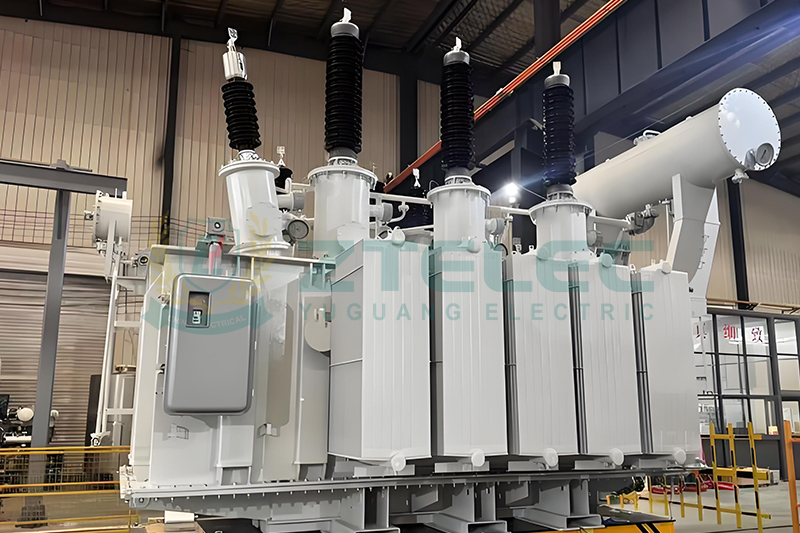
An oil-immersed transformer is the most widely used type of power transformer. Its core structure places the windings and magnetic core inside insulating mineral oil. The transformer oil serves two important functions: electrical insulation and heat dissipation.
During operation, heat generated by the windings and core is transferred to the insulating oil. The oil then circulates naturally or through forced circulation systems to carry heat to radiators or cooling equipment, where it is released into the surrounding air. Common cooling methods include ONAN (Oil Natural Air Natural), ONAF (Oil Natural Air Forced), and OFAF (Oil Forced Air Forced).
Because of their excellent cooling capability, mature manufacturing technology, and relatively low cost, oil-immersed transformers have long dominated industrial power distribution and outdoor substations. From rural distribution networks to large industrial substations and renewable energy power stations, oil-filled transformers are widely used around the world.
One of the biggest advantages of oil-immersed transformers is their suitability for high-capacity and heavy-load applications. Their long-term reliability has been proven in projects ranging from several hundred kVA to hundreds of MVA.
What Is a Dry-Type Transformer?
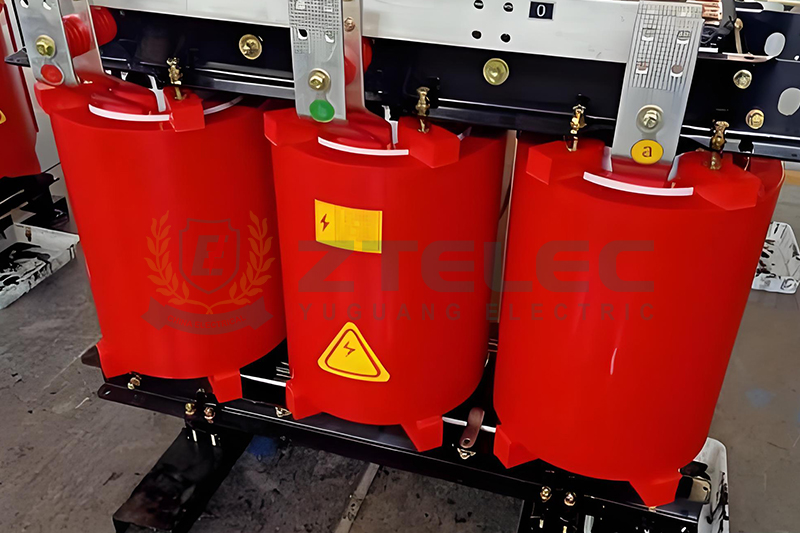
Dry-type transformers use solid insulation materials instead of liquid insulating oil. The windings are typically encapsulated using epoxy resin casting or vacuum pressure impregnation technology. Since there is no flammable liquid inside the transformer, the risks of oil leakage, fire, or explosion are significantly reduced.
Dry-type transformers rely on natural air cooling or forced air cooling through fans. Their compact structure allows installation close to load centers, reducing cable length and lowering line losses in low-voltage distribution systems.
As urban buildings become more densely populated and fire safety regulations become stricter, dry-type transformers have become increasingly popular in commercial buildings, hospitals, airports, metro systems, and data centers. In enclosed or underground electrical rooms, dry-type transformers are often the preferred solution.
In addition, advances in epoxy resin insulation technology have improved the moisture resistance, short-circuit strength, and mechanical stability of modern dry-type transformers, making them suitable for more demanding environments.
Key Differences Between Oil-Immersed and Dry-Type Transformers
Cooling Performance and Operating Efficiency
Oil-immersed transformers generally provide superior cooling performance. Transformer oil has excellent thermal conductivity and can effectively dissipate heat from winding hot spots, maintaining lower operating temperatures under heavy loads.
Thanks to their efficient cooling systems, oil-filled transformers are ideal for high-capacity, continuous-duty applications such as industrial manufacturing, mining operations, utility substations, and renewable energy projects.
Dry-type transformers are limited by the lower efficiency of air cooling. Under the same capacity rating, they are usually larger in size. Although some manufacturers now offer higher-capacity dry-type units, oil-immersed transformers still dominate ultra-large-capacity applications.
Fire Safety Performance
Fire safety is one of the most significant differences between the two transformer types.
Oil-immersed transformers contain a large volume of insulating oil, which is combustible. In the event of internal faults or short circuits, there is a risk of overheating, oil vapor generation, and even fire.
Therefore, indoor installation of oil-filled transformers often requires additional fire protection measures such as fire-resistant walls, oil containment pits, explosion-proof doors, and automatic fire suppression systems.
Dry-type transformers contain no flammable liquid, giving them much higher intrinsic fire safety. Even in the event of insulation failure, they are unlikely to cause large-scale fire spread, making them highly suitable for densely populated or enclosed environments.
For shopping malls, hospitals, office buildings, schools, and metro stations, dry-type transformers can significantly reduce fire protection complexity and improve overall safety.
Environmental Adaptability
Oil-immersed transformers offer strong environmental adaptability. Their sealed oil tank design effectively isolates internal components from moisture, dust, and salt contamination, allowing reliable operation in coastal, humid, dusty, or polluted environments.
They also perform well in low-temperature conditions, making them ideal for cold climates and outdoor installations.
Dry-type transformers are generally more sensitive to environmental conditions. In humid, dusty, or corrosive environments, the insulation system may gradually deteriorate over time. For chemical plants, coastal facilities, or high-humidity areas, high-protection-level designs such as IP54 enclosures are often recommended.
Noise Level Comparison
Under the same capacity rating, dry-type transformers usually generate slightly higher operating noise than oil-immersed transformers. This is mainly because transformer oil naturally absorbs vibration and reduces sound transmission.
In addition, cooling fans used in forced-air systems can create extra mechanical noise. For hospitals, schools, office buildings, and other noise-sensitive environments, low-noise transformer designs and additional vibration isolation measures are often necessary.
Installation and Maintenance Cost Analysis
Equipment Purchase Cost
From the perspective of equipment pricing, oil-immersed transformers are generally more economical. Under the same voltage and capacity ratings, their purchase price is usually 20% to 50% lower than dry-type transformers.
For large industrial projects with limited budgets, this cost difference can be highly significant.
Supporting Construction Cost
Although oil-filled transformers are cheaper as equipment, indoor installation requires additional fire protection and oil containment infrastructure, including fire-resistant barriers, oil pits, explosion-proof systems, and dedicated fire suppression equipment.
In urban buildings or underground substations, these construction costs may become substantial and can even exceed the price difference between the transformer types.
Dry-type transformers do not require oil pits and generally have lower building infrastructure requirements, making them more suitable for compact electrical rooms and modern urban projects.
Long-Term Maintenance Cost
Oil-immersed transformers require regular oil testing, including dissolved gas analysis (DGA), dielectric strength testing, and moisture analysis. Breathers, seals, and cooling systems also need periodic inspection and maintenance.
Older units may require oil filtration or oil replacement, increasing long-term maintenance workload and operating costs.
Dry-type transformers require simpler routine maintenance, mainly involving dust cleaning, fan inspection, and insulation checks. However, if winding insulation becomes severely aged or moisture-damaged, repair can be more difficult and expensive.
Applications Best Suited for Oil-Immersed Transformers
Oil-immersed transformers are more suitable for high-capacity outdoor and harsh-environment applications, including industrial plants, mining sites, utility substations, wind farms, solar power stations, and heavy manufacturing facilities.
For projects requiring continuous heavy-load operation, lower initial investment, and sufficient installation space, oil-filled transformers often provide better economic value.
In humid, cold, or highly polluted environments, sealed oil-immersed structures also tend to offer greater long-term reliability than open dry-type designs.
Applications Best Suited for Dry-Type Transformers
Dry-type transformers are ideal for densely populated areas, fire-sensitive environments, and projects with limited installation space.
Typical applications include commercial buildings, hospitals, metro systems, airports, data centers, underground parking garages, high-rise buildings, and smart building projects.
Their oil-free and fire-resistant characteristics help simplify building fire protection systems while improving installation flexibility inside buildings.
In modern urban power distribution systems, dry-type transformers have become one of the most important indoor transformer solutions.
How to Choose the Right Transformer for Your Project
Transformer selection should not be based solely on equipment price. Instead, the entire lifecycle cost and project environment should be considered comprehensively.
The installation location and local fire protection regulations are often the most critical factors. If the transformer is installed inside a building, fire safety requirements and related infrastructure costs must be carefully evaluated.
Capacity demand is another important consideration. For projects above 2500kVA, oil-immersed transformers generally provide greater technical maturity and reliability, while dry-type transformers are highly suitable for medium and low-capacity indoor distribution systems.
Environmental conditions must also be analyzed carefully. In humid, corrosive, or dusty environments, transformer protection level and insulation durability become especially important.
Finally, total lifecycle cost should be assessed, including purchase price, energy losses, maintenance expenses, installation space, and future upgrade costs, rather than focusing only on the initial equipment quotation.
Both oil-immersed transformers and dry-type transformers have their own advantages, and neither can be considered the universal best solution for every project.
Oil-immersed transformers remain dominant in industrial and outdoor applications due to their high capacity, lower cost, and proven long-term reliability. Dry-type transformers, on the other hand, have become the preferred choice for modern urban buildings thanks to their oil-free safety, excellent fire resistance, and flexible installation characteristics.
The best transformer solution should always be determined based on installation conditions, capacity requirements, fire regulations, project budget, and long-term maintenance strategy. A clear understanding of the differences between these two transformer types is essential for building a safer, more efficient, and more reliable power distribution system.
oil immersed vs dry type transformer
dry type transformer
transformer selection
Oil immersed transformer
dry-type transformer energy efficiency standards
- more+releated article
- 2026-05-18Oil-Immersed Transformer vs Dry-Type Transform
- 2026-05-15Dry-Type Transformer Energy Efficiency Standar
- 2026-05-142026 Dry-Type Transformer Price Factors: Capac
- 2026-05-13What Is an Oil-Immersed Transformer? Working P
- 2026-05-13Medium Voltage Dry-Type Transformers in Solar
- 2026-05-11How Long Does an Oil-Immersed Transformer Last
- 2026-05-08Modern Power System Dry-Type Transformer Insta
- 2026-05-07Oil-Immersed Transformer Overheating: Causes,
- 2026-05-07Dry-Type Transformers for Data Centers: 2026 R
- 2026-04-30Air-Core Reactor vs Iron-Core Reactor: How to
- ELECTRICAL INSULATION BOARD MATERIALS
- ELECTRICAL INSULATION MATERIALS
- POWER TRANSFORMER
- ENAMELED WIRE
- SWITCHGEAR



oil immersed vs dry type transformer
Oil immersed transformer
transformer selection
dry type transformer
IEC transformer standard
dry-type transformer energy efficiency standards
ANSI transformer efficiency
SCB11 transformer
2026 dry-type transformer
dry-type transformer price
dry-type transformer capacity
distribution transformer
oil filled transformer
Power transformer
medium voltage dry-type transformer
solar transformer
renewable energy transformer
oil immersed transformer lifespan
oil immersed transformer maintenance
transformer lifecycle
transformer insulation aging
dry type transformer maintenance
dry type transformer sizing
dry type transformer installation
dry type transformer temperature monitoring