
23 kV Transformer Standards: IEC vs IEEE/ANSI vs GB
Buying a 23 kV transformer sounds simple until the tender documents arrive. One buyer cites IEC 60076. Another asks for IEEE C57.12.00. A third project requires GB 1094.
All three standard families describe safe, reliable power transformers. But they define voltage classes, temperature limits, tolerances and tests differently.
Quick answer: choose one primary standard, write exact insulation and loss values into the contract, and define the tests and documents you need. The sections below explain why.
Why 23 kV Is a Special Case
No Single Standard Owns 23 kV
The 23 kV level is common in Southeast Asia, Latin America, the Middle East and North America. Each region maps it to a different insulation class.
How Each System Classifies It
IEC: a 22 kV or 23 kV system falls in the 24 kV highest-voltage-for-equipment class.
IEEE: it generally belongs to the 25 kV class.
GB: standards focus on 10 kV, 35 kV and 110 kV, so a 23 kV unit is usually a customized export design built on GB or IEC rules.
What Buyers Should Do First
State the nominal system voltage, the highest voltage for equipment and the insulation levels in the same document.
The Three Standard Families at a Glance
IEC 60076: The International Reference
IEC 60076 is a multi-part series used in more than 100 countries.
Part 1 covers general requirements. Part 2 covers temperature rise. Part 3 covers insulation levels and dielectric tests.
Part 5 covers short-circuit withstand. Part 10 covers sound levels. Part 11 covers dry type units, and Part 20 covers energy performance.
IEEE/ANSI C57: The North American System
IEEE C57.12.00 sets general requirements for liquid-immersed transformers. IEEE C57.12.90 defines the test code.
For dry type units, IEEE C57.12.01 and C57.12.91 apply. Pad-mounted designs follow IEEE C57.12.34 (three-phase) and C57.12.38 (single-phase).
IEEE C57.91 is the loading guide.
GB 1094: China's National Standard
GB 1094 is largely harmonized with IEC 60076. This makes Chinese-built transformers easy to align with international projects.
GB 1094.1 covers general requirements, GB 1094.2 temperature rise, GB 1094.3 insulation, and GB 1094.5 short-circuit withstand. GB 1094.11 covers dry type units.
Product rules sit in GB/T 6451 (oil-immersed) and GB/T 10228 (dry type). Efficiency is set by GB 20052.
Insulation Levels at 23 kV
IEC and GB Requirements
A 24 kV class winding is tested at 50 kV power frequency.
The lightning impulse level is typically 95 kV or 125 kV, depending on the insulation list and local overvoltage exposure.
IEEE Requirements
The 25 kV class uses Basic Impulse Insulation Level (BIL). Common values are 125 kV and 150 kV.
The higher value is often chosen for overhead networks with frequent lightning.
Practical Tip
The numbers are close but not identical, and test methods differ. Always write the exact kV values for AC withstand and impulse withstand into the contract.
Temperature Rise and Insulation Class
Oil-Immersed Transformer
IEC 60076-2 and GB 1094.2 limit the average winding rise to 65 K and the top-oil rise to 60 K, based on a 20 °C annual average ambient.
IEEE uses a 65 °C average winding rise. Many US units are dual rated at 55/65 °C.
Dry Type and Cast Resin Transformer
The limit depends on the insulation system. A cast resin transformer with class F insulation is commonly designed for a 100 K rise. Class H allows 125 K.
IEEE dry type standards use similar classes but define ambient and hot-spot allowances in their own way.
Ambient Conditions
High altitude or a hot climate requires derating or a larger design, whichever standard you choose.
Losses and Energy Efficiency Rules
Regional Regulations
European Union: Ecodesign Tier 2 sets maximum no-load and load losses.
United States: the Department of Energy sets minimum efficiency under 10 CFR Part 431.
China: GB 20052 defines efficiency grades. State utilities increasingly demand Grade 2 or Grade 1 designs.
Loss Tolerances
IEC allows a positive tolerance on each loss and on total losses. IEEE C57.12.00 allows a tighter tolerance on total losses.
When comparing quotes, confirm that guaranteed losses use the same basis and tolerance.
Impedance and Short-Circuit Withstand
Impedance Tolerance
Impedance affects voltage regulation and fault current.
IEC and GB typically allow ±10 percent for two-winding units. IEEE commonly allows ±7.5 percent.
Ratio tolerance is usually ±0.5 percent in all three systems.
Short-Circuit Withstand
IEC 60076-5, GB 1094.5 and IEEE C57.12.00 all require the transformer to survive a defined fault current for a defined time.
Always give the manufacturer your system fault level. Without it, the design may be correct on paper but unsuitable for the real network.
Testing Requirements
Common Routine Tests
The core routine tests are almost the same in all three families:
Winding resistance, ratio and vector group, no-load loss, load loss and impedance, applied voltage, and induced voltage.
Where the Standards Differ
IEC and GB place strong emphasis on partial discharge measurement and treat lightning impulse as a type test.
IEEE treats some impulse tests as design tests, and its test categories use different terms.
Witnessed Testing
Name the standard, the test list and the acceptance criteria in the purchase order. Our guide on type tests and routine tests explains which reports to request.
Differences by Transformer Type
Oil-Immersed Transformer
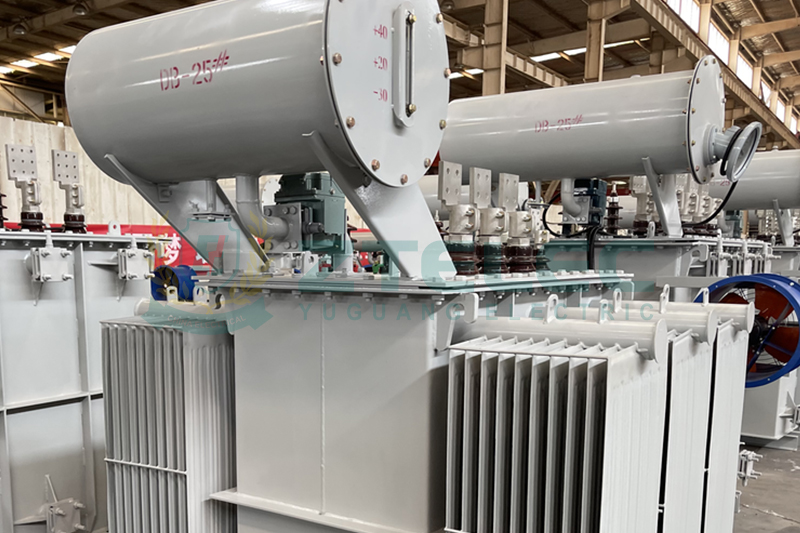
The most common 23 kV choice for utilities and industry. IEC and GB designs often use sealed tanks with corrugated fins. IEEE designs often use conservator or sealed tanks with their own bushing and accessory layouts.
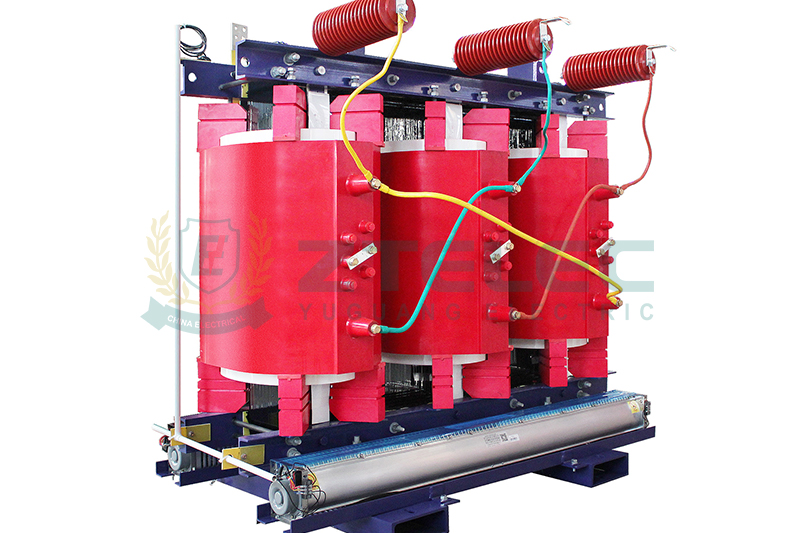
Dry Type Transformer and Cast Resin Transformer
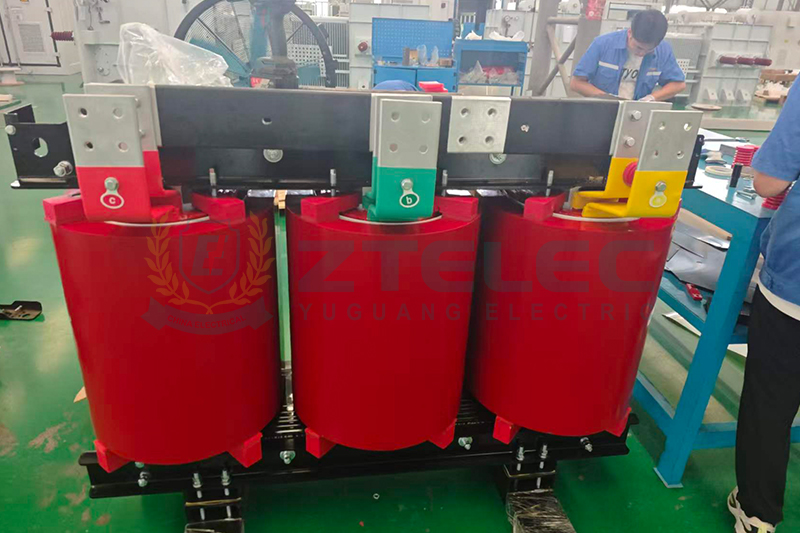
Preferred for buildings, tunnels and sites where fire safety matters. A cast resin transformer adds moisture and dust resistance.
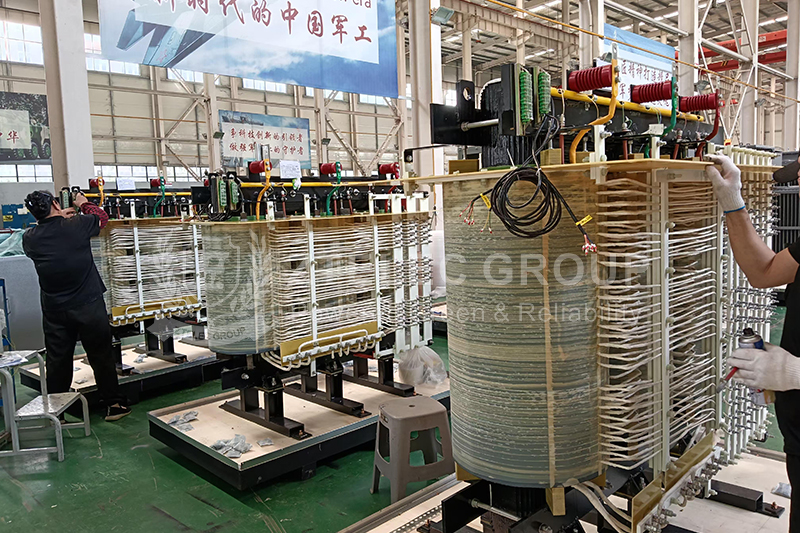
At 23 kV, vacuum-cast coils need strong partial discharge control. The standard you pick affects test limits and enclosure ratings.
Pad-Mounted Transformer and Compact Substation
In North America, a pad-mounted transformer follows IEEE C57.12.34 with tamper-resistant compartments and loop-feed or radial-feed options.
In IEC markets, the equivalent is a compact substation built to IEC 62271-202. It integrates the transformer, medium voltage switchgear and low voltage panel.
Other Differences That Affect Your Quote
Frequency
IEC and GB systems mostly run at 50 Hz. North American systems run at 60 Hz.
A 60 Hz transformer used on a 50 Hz grid needs more core steel to avoid saturation. The reverse is usually easier, but the loss and noise figures change.
Sound Level
IEC 60076-10 defines sound power and sound pressure measurement. IEEE and NEMA use their own methods and limits.
If the transformer sits near offices or homes, state the maximum dB(A) at a stated distance. Do not rely on the standard alone.
Bushings and Terminals
North American designs often use IEEE-style bushings, elbow connectors and dead-front terminations. IEC designs use DIN or EN bushings and cable boxes.
Mismatched terminals are a common reason for site delays. Confirm the connection type with your cable supplier before ordering.
Tap Changers
Most 23 kV distribution units use an off-circuit tap changer with a ±2 x 2.5 percent range. Utilities that need voltage control may require an on-load tap changer.
State the tap range, the tap position for rated voltage and whether tapping is on the high voltage side.
Protection Devices
Oil-immersed units may need a Buchholz relay, pressure relief device, oil level gauge and thermometer. Dry type units may need winding temperature sensors and a fan control unit.
IEC and IEEE lists of standard accessories are different, so name each device you want.
Common Mistakes When Citing Standards
Citing Only the Standard Number
Writing “per IEC” is not enough. Name the part, the edition year and the clauses that apply.
Ignoring Local Regulations
Efficiency rules, fire codes and import requirements can override the base standard. Check them before you finalize the design.
Forgetting Site Conditions
A transformer built to the right standard can still fail if altitude, humidity, pollution or ambient temperature were not stated. Always attach a site data sheet to the enquiry.
Quick Comparison Table
| Item | IEC 60076 | IEEE/ANSI C57 | GB 1094 |
|---|---|---|---|
| Voltage class for 23 kV | Um 24 kV | 25 kV class | Custom, based on 24 kV |
| Insulation level | 50 kV AC, 95/125 kV LI | 125 or 150 kV BIL | 50 kV AC, 95/125 kV LI |
| Oil winding rise | 65 K average | 65 °C average | 65 K average |
| Impedance tolerance | ±10% | ±7.5% | ±10% |
| Frequency | 50 Hz or 60 Hz | Mainly 60 Hz | 50 Hz |
| Efficiency rule | EU Tier 2 | US DOE 10 CFR 431 | GB 20052 |
How to Choose the Right Standard
Follow the Grid
If your network follows IEC, specify IEC 60076. If it follows North American practice, specify IEEE C57 and the related ANSI accessory standards.
Buying from China
GB 1094 is a practical base because it mirrors IEC. Many suppliers can also certify against IEC 60076 or IEEE on request, but agree this before the design is frozen.
Avoid Mixed Standards
A contract that cites three standards without an order of precedence invites disputes at the factory acceptance test.
Specification Checklist for a 23 kV Transformer
Electrical Data
List the nominal voltage and highest voltage for equipment as separate lines. Add the vector group, such as Dyn11 or Yyn0, and the tap range, such as ±2 x 2.5 percent.
Site and Performance Data
State the cooling method, ambient design temperature, altitude and enclosure protection class. Add guaranteed no-load and load losses with tolerance, plus sound level in dB(A).
Documents
Define the test reports, drawings, nameplate details and conformity certificates you need. Clear documents prevent customs delays and commissioning problems.
Frequently Asked Questions
Is a 23 kV transformer IEC or IEEE compliant?
It can be either. The voltage rating alone does not decide the standard. The insulation class, test program and accessories do.
Can one transformer meet IEC and GB at the same time?
Often yes, because GB 1094 is closely aligned with IEC 60076. Confirm specific clauses and tolerances with the manufacturer in writing.
Which standard suits a dry type transformer at 23 kV?
Use IEC 60076-11 or GB 1094.11 for IEC-style markets, and IEEE C57.12.01 for North American projects.
IEC, IEEE/ANSI and GB all produce dependable transformers. Their voltage classes, temperature limits, tolerances and tests are not interchangeable.
At 23 kV the gap is more visible, because no single standard owns this voltage.
Pick one primary standard, list exact insulation and loss values, and define tests and documents in the contract. Then an oil-immersed transformer, a dry type transformer or a compact substation can be delivered on time and accepted without dispute.
Planning a 23 kV project? Send your voltage, capacity, standard and site conditions to our engineering team for a tailored quotation.
23 kV transformer
IEEE C57.12.00
dry type transformer
GB 1094
IEC 60076
- more+releated article
- 2026-11-1423 kV Transformer Standards: IEC vs IEEE/ANSI
- 2026-11-13IEC 60076 Transformer Tests: Routine, Type &am
- 2026-11-12Outdoor Transformer Installation: Clearances &
- 2026-11-113500 kVA Transformer Oil: Mineral vs Ester vs
- 2026-11-103500 kVA Transformer: EU Tier 2 vs US DOE Loss
- 2026-11-09ZTELEC GROUP 2026 Year-End Promotion: Electric
- 2026-11-06Dyn11 vs Yyn0: Choosing the Vector Group for a
- 2026-11-05Sealed Tank vs Conservator Design for a 23 kV
- 2026-11-04ONAN vs ONAF Cooling for a 3500 kVA Transforme
- 2026-11-033500 kVA Transformer Price 2026: Cost Drivers
- ELECTRICAL INSULATION BOARD MATERIALS
- ELECTRICAL INSULATION MATERIALS
- POWER TRANSFORMER
- ENAMELED WIRE
- SWITCHGEAR

FR-4 Copper-Free Laminate | High-Performance Insulation Material

FR-4 Copper Clad Laminate Manufacturer & Supplier
IEEE C57.12.00
GB 1094
IEC 60076
23 kV transformer
23 kV transformer standards
dry type transformer
oil-immersed transformer
routine test
transformer tests
special test
type test
transformer clearances
outdoor transformer installation
transformer fire safety
pad-mounted transformer
oil filled transformers
3500 kVA transformer oil
mineral oil vs ester vs silicone
Oil immersed transformer
DOE transformer efficiency
transformer loss limits
EU Tier 2 transformer
3500 kVA transformer
electrical equipment
insulating materials