
Oil Filled Self Cooled Transformer: ONAN Basics
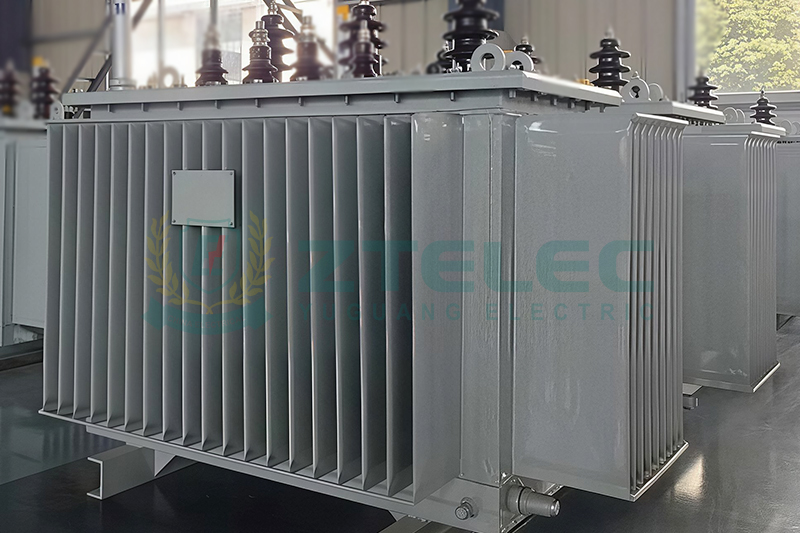
An oil filled self cooled transformer is one of the most common machines in any power network. It is simple, rugged and reliable, and it can run for decades with modest maintenance.
The industry describes this cooling method with the code ONAN. This guide explains what ONAN means, how the cooling works, what parts are involved and where these units are used.
Whether you are a buyer, an engineer or a project developer, understanding the basics of oil-immersed transformers helps you specify the right unit and avoid costly mistakes.
What Does ONAN Mean?
ONAN is a four-letter cooling code defined in IEC 60076. Each letter describes part of the cooling system.
The first letter, O, means the internal cooling medium is mineral oil or another liquid with a flash point below 300°C. The second letter, N, means the oil flows by natural convection, not by a pump.
The third letter, A, means the external cooling medium is air. The fourth letter, N, means the air moves naturally around the tank and radiators, without fans.
In short, an ONAN transformer is oil filled and self cooled. It has no pumps and no fans, so it has very few moving or powered parts to fail.
How ONAN Cooling Works
Every transformer produces heat. Current in the windings causes load loss, and the magnetic core causes no-load loss. This heat must leave the transformer, or the insulation will age quickly.
In an ONAN design, the core and windings sit inside a tank full of insulating oil. When the windings heat the oil, it becomes lighter and rises to the top of the tank.
The hot oil then flows into radiators or tank fins on the outside. There, it gives up heat to the surrounding air. As the oil cools, it becomes denser and sinks, returning to the bottom of the tank.
This loop is called the thermosiphon effect. It keeps running as long as the transformer is loaded, with no external power needed for cooling.
Main Components of an ONAN Transformer
Core and Windings
The core is built from laminated silicon steel, which carries the magnetic flux with low loss. The windings are made of copper or aluminum and are insulated with paper and pressboard impregnated with oil.
Tank and Radiators
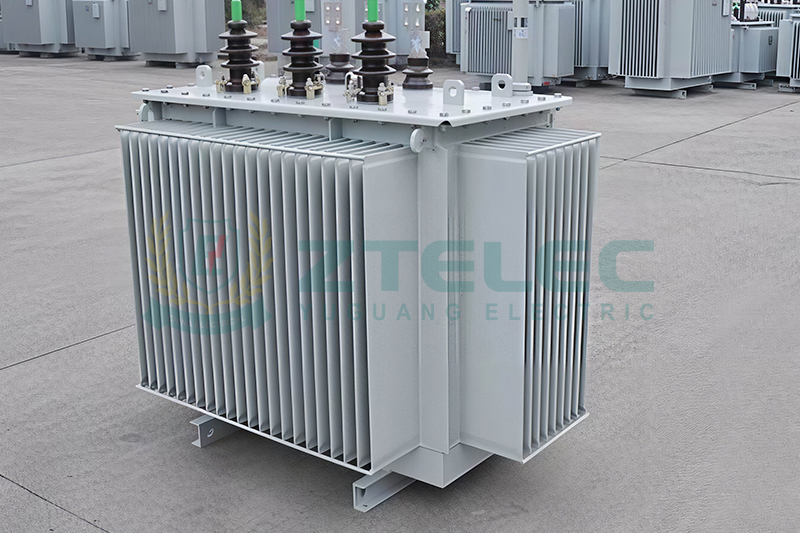
The steel tank holds the active part and the oil. Radiators or corrugated fins increase the surface area for heat exchange. Larger ratings need more radiator panels to dissipate heat naturally.
Insulating Oil
Oil does two jobs. It insulates the live parts from each other and from the tank, and it carries heat away from the windings. Mineral oil is most common, while ester oils are used where fire safety or environmental needs are higher.
Conservator or Sealed Design
A conservator tank sits above the main tank and gives the oil room to expand and contract as temperature changes. In a hermetically sealed design, the tank is fully closed and the corrugated walls flex to absorb expansion.
Breather, Buchholz Relay and Protection Devices
A silica gel breather keeps moisture out of the conservator. A Buchholz relay detects gas or oil surge from internal faults. Pressure relief devices, oil level gauges and temperature indicators complete the protection package.
Bushings and Tap Changer
Bushings carry current through the tank wall. An off-circuit tap changer or an on-load tap changer adjusts the voltage ratio to match system needs.
ONAN vs ONAF vs OFAF: Cooling Class Comparison
ONAN is the base cooling class. Many larger transformers add fans or pumps to raise their capacity. The table below shows the main differences.
| Cooling Class | Oil Circulation | Air Circulation | Typical Use |
|---|---|---|---|
| ONAN | Natural | Natural | Distribution and small to medium power transformers |
| ONAF | Natural | Forced by fans | Medium to large transformers needing extra capacity |
| OFAF | Forced by pumps | Forced by fans | Large power transformers with high losses |
Many power transformers carry dual ratings, such as ONAN/ONAF. The ONAN rating applies without fans, and the higher ONAF rating applies when fans start. This gives flexibility during peak load periods.
Advantages of Oil Filled Self Cooled Transformers
High Reliability
With no fans or pumps, there are fewer parts to break and no auxiliary power supply to lose. The cooling keeps working even during a partial power failure.
Low Noise
Without fans, the only sound is the core hum. That makes ONAN units a good fit for residential areas, commercial districts and sites with noise limits.
Lower Operating Cost
Self cooling uses no extra electricity. Maintenance is also simpler, since there are no cooling motors or pump seals to service.
Excellent Overload Tolerance
Oil has a high heat capacity. This helps oil-immersed transformers handle short-term overloads better than many dry-type designs of the same size.
Competitive Price
For a given kVA rating, an oil filled transformer typically costs less than a cast resin unit. That makes it attractive for large utility and industrial projects.
Limitations to Consider
Oil is flammable, so fire protection must be considered. Outdoor sites need an oil containment pit or bund to catch leaks. Indoor installations may need fire-rated rooms or barriers.
Natural cooling also sets a limit on capacity for a given size. At very high ratings, the radiator area becomes large, and fans or pumps become practical.
Oil needs periodic testing to check moisture, acidity and dissolved gases. This is normal practice, but it does require a maintenance plan.
Where ONAN Transformers Are Used
Utility distribution networks are the largest market. Pole-mounted and pad-mounted units step medium voltage down to low voltage for homes and businesses.
Industrial plants use ONAN units to supply motors, furnaces and process equipment. Their strong overload capability and long life suit heavy-duty work.
Substations rely on ONAN power transformers for step-up and step-down duty. Rated from a few MVA to tens of MVA, they form the backbone of many grids.
ONAN Transformers in Renewable Energy Projects
Solar and wind farms need transformers that are robust, efficient and able to run for years in remote places. Photovoltaic and wind power transformers are often built as oil filled units with ONAN cooling.
Their duty is demanding. Output changes with sunshine and wind, so loading rises and falls quickly. Oil's thermal inertia helps absorb these swings without large temperature spikes.
Self cooling also suits unmanned sites. With no fans or pumps, there is less to maintain and fewer causes of downtime. Many designs use sealed tanks and ester oil to cut maintenance and improve fire safety.
Special features may be added for renewable duty. Examples include split windings for multiple inverters, low-loss cores for variable load, and designs that handle harmonics from power electronics.
Key Ratings and Specifications to Know
When you request a quotation for an ONAN transformer, be ready to provide the main technical details.
Rated power is given in kVA or MVA. Voltage ratings include primary, secondary and any tapping range. Frequency is usually 50Hz or 60Hz, depending on your region.
The vector group, such as Dyn11 or YNd11, defines the winding connection and phase shift. Impedance affects voltage regulation and short-circuit current.
Loss levels matter for efficiency. Many buyers specify no-load and load loss limits based on IEC, EU or national standards. Temperature rise limits are normally 65K for windings and 60K for top oil.
Installation and Site Conditions
ONAN transformers need free air around the tank and radiators. Poor ventilation raises oil temperature and cuts the available capacity, so keep clearances as the manufacturer advises.
High altitude or high ambient temperature reduces cooling effectiveness. At such sites, the transformer may need derating or a larger radiator design.
Plan for oil containment, a firm foundation and safe access for inspection. Grounding, surge protection and correct cable terminations are also essential.
Basic Maintenance Tips
Inspect oil level, leaks and gauges on a regular schedule. Check the breather and replace silica gel when it changes color.
Take oil samples for dissolved gas analysis and moisture testing. These tests can reveal early signs of overheating or insulation problems.
Keep radiators clean, and check bushings, gaskets and tap changer operation. Good records make it easier to spot trends over time.
How to Choose the Right ONAN Transformer
Start by sizing the transformer for your real load, with some margin for growth. Then decide between standard and low-loss designs based on lifecycle cost, not just price.
Consider the site: indoor or outdoor, altitude, climate and fire risk. Choose between conservator and sealed tank types, and between mineral and ester oil, according to your safety and maintenance needs.
Finally, select a manufacturer with proven test facilities and type test reports. Ask for routine test certificates and confirm warranty and service support before you order.
Frequently Asked Questions
What is an oil filled self cooled transformer?
It is a transformer whose core and windings sit in insulating oil and which is cooled by natural oil and air circulation. The cooling class is ONAN.
Is ONAN the same as ONAF?
No. ONAN relies on natural air flow, while ONAF adds fans to increase cooling and capacity.
How long does an ONAN transformer last?
With good loading and maintenance, a well-built unit can serve 30 years or more.
Can ONAN transformers be used outdoors?
Yes. Their steel tanks and radiators are designed for outdoor service, provided the right oil containment and protection are in place.
The oil filled self cooled transformer is a proven, dependable design. ONAN cooling gives quiet operation, low running cost and strong overload tolerance, with few parts to maintain.
From utility grids to industrial plants, and from oil-immersed transformers in substations to photovoltaic and wind power transformers in renewable farms, ONAN units power the modern world. Share your specifications with a qualified manufacturer to get a design and quotation that fit your project.
1250kVA epoxy resin cast dry-type transformer price
1250kVA transformer price
dry-type transformers
prefabricated substation
prefabricated substation types
- more+releated article
- 2026-11-18Oil Filled Self Cooled Transformer: ONAN Basic
- 2026-11-17What Is a Prefabricated Substation? Types and
- 2026-11-16Cast Resin vs VPI Dry Type Transformers: Key D
- 2026-11-1423 kV Transformer Standards: IEC vs IEEE/ANSI
- 2026-11-13IEC 60076 Transformer Tests: Routine, Type &am
- 2026-11-12Outdoor Transformer Installation: Clearances &
- 2026-11-113500 kVA Transformer Oil: Mineral vs Ester vs
- 2026-11-103500 kVA Transformer: EU Tier 2 vs US DOE Loss
- 2026-11-09ZTELEC GROUP 2026 Year-End Promotion: Electric
- 2026-11-06Dyn11 vs Yyn0: Choosing the Vector Group for a
- ELECTRICAL INSULATION BOARD MATERIALS
- ELECTRICAL INSULATION MATERIALS
- POWER TRANSFORMER
- ENAMELED WIRE
- SWITCHGEAR

FR-4 Copper-Free Laminate | High-Performance Insulation Material

FR-4 Copper Clad Laminate Manufacturer & Supplier
1250kVA epoxy resin cast dry-type transformer price
1250kVA transformer price
dry-type transformers
what is a prefabricated substation
prefab substation
prefabricated substation types
prefabricated substation
cast resin vs VPI dry type transformer
dry-type transformer
cast-resin transformer
VPI transformer
oil-immersed transformer
IEEE C57.12.00
IEC 60076
23 kV transformer standards
23 kV transformer
dry type transformer
GB 1094
type test
transformer tests
special test
routine test
transformer fire safety
transformer clearances
outdoor transformer installation