
Oil-Immersed Transformers for Industrial Plants: Rated Parameters, Standards and Selection Guide
Stable power supply in industrial plants is the core foundation for ensuring continuous production. Among various power distribution equipment, oil-immersed transformers have long dominated industrial power systems due to their strong current-carrying capacity, large overload margin, excellent heat dissipation, stable operation, and long service life.
Especially in large-capacity power supply scenarios, continuous production workshops, and high-load operating environments, oil-immersed transformers offer better economy and reliability compared with dry-type transformers. For factory construction, equipment upgrades, and power distribution system renovation projects, scientifically selecting the right oil-immersed transformer is not only related to power supply safety, but also directly affects the long-term operating cost of enterprises.
This article systematically analyzes the working principle, core rated parameters, implementation standards, and practical selection methods of oil-immersed transformers for industrial plants from an engineering application perspective, providing a complete reference for engineers, procurement personnel, and project managers.
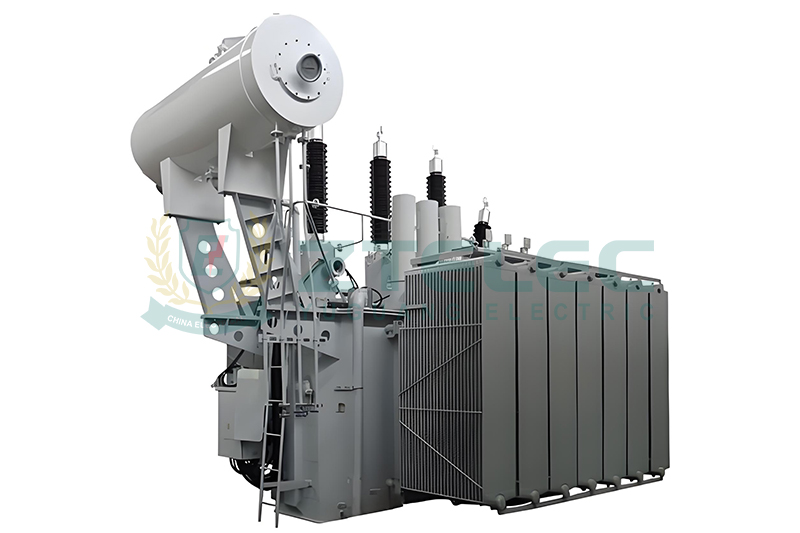
Working Principle and Structural Features of Oil-Immersed Transformers
Oil-immersed transformers use transformer oil (mineral insulating oil) to perform both insulation and heat dissipation functions. The core and windings are completely immersed inside the oil tank. During operation, the heat generated is transferred to the radiator through the natural convection of insulating oil and then dissipated into the surrounding air, achieving continuous and stable temperature control.
This structure gives oil-immersed transformers stronger thermal stability and higher reliability in high-load and long-term industrial operating environments.
Main Structural Components
Core: Made of high-permeability cold-rolled silicon steel laminations, it is the core carrier of the magnetic circuit system, and its material quality directly determines the no-load loss level.
Windings: High-voltage and low-voltage windings are usually made of copper conductors (or aluminum conductors), wrapped with insulating paper and treated with varnish, providing excellent mechanical strength and insulation performance.
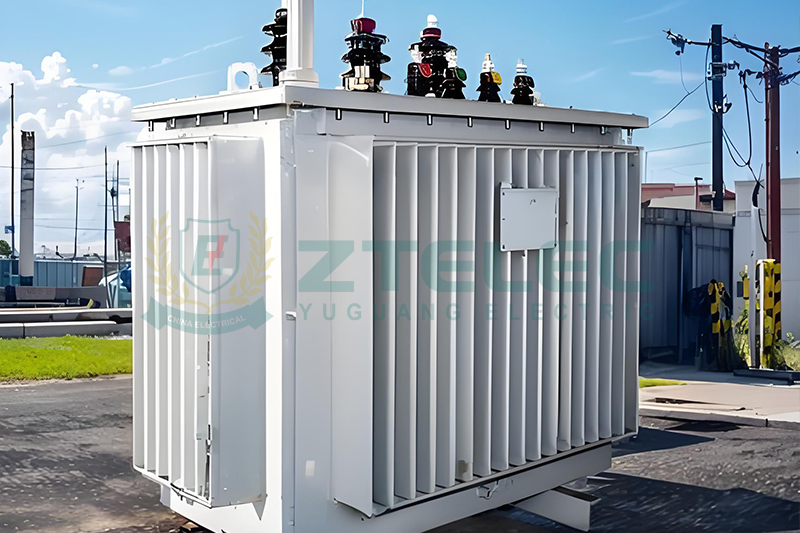
Oil Tank and Cooling Device: Usually adopts corrugated oil tanks or welded steel plate tanks with cooling tubes or radiators. Large-capacity products can be equipped with external radiators to enhance cooling capacity.
Oil Conservator (Expansion Tank): Used to compensate for oil volume expansion caused by temperature changes while preventing external moisture from entering the oil tank.
Tap Changer: Includes off-circuit tap changers and on-load tap changers for adjusting output voltage within ±5% or even larger ranges.
Protection Components: Includes thermometers, Buchholz relays, pressure relief valves, oil level indicators, etc., ensuring safe and stable equipment operation.
Compared with dry-type transformers, oil-immersed transformers have obvious advantages in industrial applications above 630kVA and under frequent overload conditions, while offering lower unit-capacity costs and better overall economy.
Detailed Explanation of Core Rated Parameters
Correct understanding of transformer nameplate parameters is the first step toward accurate selection. The following are the key parameters of commonly used oil-immersed transformers in industrial plants.
Rated Capacity (kVA)
Rated capacity refers to the apparent power that the transformer can continuously output under standard operating conditions. Common capacities for industrial plants include 315kVA, 400kVA, 500kVA, 630kVA, 800kVA, 1000kVA, 1250kVA, 1600kVA, 2000kVA, and 2500kVA.
It should be noted that transformer capacity is measured in kVA (apparent power), not kW (active power). The actual active power output must be calculated by multiplying by the power factor.
Actual Active Power = Capacity (kVA) × Power Factor
Rated Voltage and Vector Group
Industrial plants are usually connected to 10kV medium-voltage distribution systems, and the standard voltage combination is as follows:
High-Voltage Side: 10kV (some old factories use 6kV)
Low-Voltage Side: 0.4kV (400V)
Vector Group: Dyn11 (Delta / Star connection with neutral point brought out)
The Dyn11 connection can simultaneously provide 380V power voltage and 220V lighting voltage, meeting both industrial production and auxiliary lighting requirements, while also offering good suppression of third harmonics.
No-Load Loss and Load Loss
No-load loss and load loss directly determine the operating electricity cost throughout the transformer life cycle and are important bases for energy-saving selection.
| Efficiency Grade | No-Load Loss (630kVA) | Load Loss (630kVA) |
|---|---|---|
| S11 | ≤ 810W | ≤ 6200W |
| S13 | ≤ 560W | ≤ 6200W |
| S15 (Amorphous Alloy) | ≤ 200W | ≤ 6200W |
No-load loss exists continuously 24 hours a day. Even when the factory stops production, the transformer still consumes electricity. For factories with low load rates or discontinuous production shifts, the energy-saving advantages of S15 amorphous alloy transformers are especially significant.
Impedance Voltage (Uk%)
Impedance voltage is an important parameter for measuring transformer short-circuit impedance and directly affects short-circuit current size and voltage regulation performance.
The larger the Uk%: the smaller the short-circuit current, and the lower the breaking pressure on downstream switchgear.
The larger the Uk%: the more obvious the voltage fluctuation when the load changes.
The common impedance voltage standards for industrial distribution transformers are as follows:
630kVA and below: 4%
800kVA to 1600kVA: 4% or 6%
2000kVA and above: 6%
For factories with frequent starting of large-power motors, appropriately selecting transformers with higher Uk% can effectively reduce the impact of starting current on the power grid.
Temperature Rise and Insulation Class
Top Oil Temperature Rise Limit: 55K (under a 40°C ambient environment, the top oil temperature should not exceed 95°C)
Average Winding Temperature Rise Limit: 65K
Insulation Class: Usually Class A (105°C), and special reinforced insulation products can be selected for high-temperature environments.
Main Applicable Standards
When purchasing oil-immersed transformers for industrial plants, suppliers should be required to provide type test reports and energy efficiency certification documents that comply with national and international standards.
| Standard Number | Standard Name | Application Scope |
|---|---|---|
| GB 1094.1 | Power Transformers Part 1: General | Basic Technical Requirements |
| GB 1094.2 | Power Transformers Part 2: Temperature Rise for Liquid-Immersed Transformers | Temperature Rise Test Specification |
| GB 1094.5 | Power Transformers Part 5: Ability to Withstand Short Circuit | Short-Circuit Withstand Capability |
| GB 20052 | Minimum Allowable Values of Energy Efficiency and Energy Efficiency Grades for Distribution Transformers | Energy Efficiency Grade Requirements |
| JB/T 10317 | Technical Parameters of 10kV S11 Three-Phase Oil-Immersed Distribution Transformers | Domestic Distribution Transformers |
| IEC 60076 | Power Transformers | International General Standard |
Important Reminder: According to the updated GB 20052 standard, since 2021, Energy Efficiency Grade 2 (former S13 level) has become the minimum market access standard, while Energy Efficiency Grade 1 (former S15 / amorphous alloy level) is the preferred procurement target. Energy efficiency labels must be carefully verified during procurement.
Selection Points for Oil-Immersed Transformers in Industrial Plants
Accurately Calculate the Load
Based on the installed capacity of all electrical equipment in the factory, use the demand factor method to calculate active load (Pc) and apparent load (Sc).
Sc = Pc / cosφ
The power factor cosφ is generally taken as 0.85 to 0.90 and should be corrected according to actual operating data.
Determine the Number and Capacity of Transformers
The economical operating range of a single transformer is usually 60% to 80% of its rated capacity. Power supply reliability, regional supply radius, and future expansion requirements must also be comprehensively considered.
Primary load systems must use dual transformers as mutual backup. Large factory areas are recommended to adopt multi-transformer zoned power supply mode to reduce line losses and improve system reliability.
It is usually recommended to reserve 10% to 20% capacity margin for future expansion.
Prioritize High Energy Efficiency Grades
According to current energy-saving policies and enterprise cost reduction goals, the recommended priority order is:
S15 (Amorphous Alloy) > S13 (Energy Efficiency Grade 2) > S11 (No longer recommended for new projects)
For continuous production factories with annual operating hours exceeding 6000 hours, S15 transformers can usually recover the incremental investment through electricity savings within 3 to 5 years.
Confirm Installation Conditions
Outdoor installation requires outdoor-type oil-immersed transformers with a recommended protection grade of IP23 or above. Standard products can be used for indoor transformer room installation.
For areas above 1000 meters altitude, capacity should be corrected according to derating curves or plateau-type customized products should be selected. If the ambient temperature is长期 higher than 40°C, derating operation or forced air cooling devices should be considered.
Complete Protection Equipment Configuration
The high-voltage side must be equipped with high-voltage circuit breakers (or load switches + fuses) and surge arresters.
Main body protection must include gas protection, temperature protection, and pressure relief valves.
The low-voltage side should be equipped with low-voltage circuit breakers with overcurrent, short-circuit, and leakage protection functions.
Both enclosure protective grounding resistance and neutral point working grounding resistance should be ≤ 4Ω.
Common Questions and Engineering Recommendations
Which Is Better for Industrial Plants: Copper Winding or Aluminum Winding?
Copper transformers provide better conductivity, lower losses, and more compact structures, making them the preferred choice for industrial projects. Aluminum transformers have lower initial costs and are suitable for projects with limited budgets and less strict space requirements.
Can Oil-Immersed Transformers Operate Under Long-Term Overload?
Oil-immersed transformers usually allow short-term 1.3 times overload operation, but long-term overload will significantly accelerate insulation aging and shorten equipment life. It is recommended to keep the long-term operating load rate within 85% of rated capacity.
How to Determine Whether Existing Transformers Need Capacity Expansion?
If the monthly average load rate continuously exceeds 80%, or the top oil temperature frequently approaches the limit value, capacity expansion evaluation should be carried out as soon as possible to avoid equipment failure caused by long-term high-load operation.
The selection of oil-immersed transformers for industrial plants is a comprehensive decision involving electrical design, investment control, and long-term operation and maintenance management. Accurate load calculation, reasonable capacity configuration, compliant energy efficiency grades, and complete protection systems are the keys to ensuring factory power supply safety and reducing full life-cycle costs.
During actual project implementation, it is recommended that design institutes, equipment manufacturers, and power supply departments jointly conduct technical clarification to ensure that the transformer selection方案 complies with local grid access specifications and the latest national energy efficiency standards, helping enterprises establish safer, more efficient, and more energy-saving power supply systems.
oil immersed transformer lifespan
oil immersed transformer maintenance
transformer lifecycle
transformer insulation aging
dry type transformer temperature monitoring
- more+releated article
- 2026-05-11How Long Does an Oil-Immersed Transformer Last
- 2026-05-08Modern Power System Dry-Type Transformer Insta
- 2026-05-07Oil-Immersed Transformer Overheating: Causes,
- 2026-05-07Dry-Type Transformers for Data Centers: 2026 R
- 2026-04-30Air-Core Reactor vs Iron-Core Reactor: How to
- 2026-04-29Compact Enclosed Transformer for Smart Grid: T
- 2026-04-2812-Pulse and 24-Pulse Phase-Shifting Transform
- 2026-04-27Oil-Immersed Transformers for Industrial Plant
- 2026-04-25Why Dry-Type Transformers Are Preferred for Ho
- 2026-04-24Enclosed Transformer Outdoor Solutions: IP Pro
- ELECTRICAL INSULATION BOARD MATERIALS
- ELECTRICAL INSULATION MATERIALS
- POWER TRANSFORMER
- ENAMELED WIRE
- SWITCHGEAR



transformer insulation aging
transformer lifecycle
oil immersed transformer lifespan
oil immersed transformer maintenance
dry type transformer installation
dry type transformer temperature monitoring
dry type transformer maintenance
dry type transformer sizing
transformer cooling system failure
transformer overheating causes
oil immersed transformer overheating
transformer oil temperature
harmonic mitigation
dry type transformer
K factor transformer
data center transformer
Cast resin transformer
insulation oil degradation
DGA analysis transformer
transformer fault analysis
oil immersed transformer failure
smart grid transformer
compact enclosed transformer
integrated distribution transformer
compact transformer substation