
Dry-Type Transformers for Data Centers: 2026 Reliable Power Distribution Guide
As data centers continue to scale in capacity and complexity, transformer selection plays a direct role in system reliability, efficiency, and safety. Dry-type transformers have become the preferred solution in modern facilities due to their fire safety, low maintenance, and strong performance under nonlinear loads.
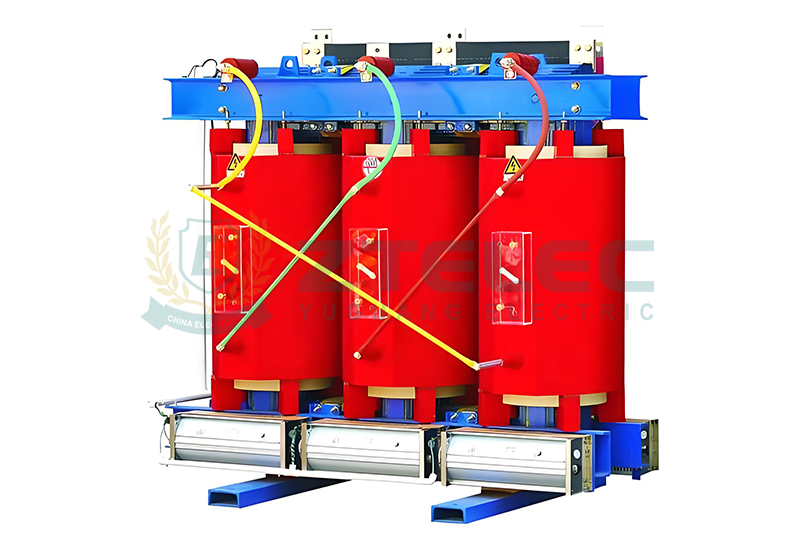
Why Data Centers Prefer Dry-Type Transformers
Oil-filled transformers present inherent limitations in data center environments. Fire risks associated with insulating oil conflict with strict fire protection standards. Oil leakage can threaten underfloor cable systems, while periodic oil maintenance does not align with 24/7 continuous operation requirements.
Dry-type transformers eliminate these concerns by using solid insulation materials such as epoxy resin or gas insulation. More importantly, they are designed to handle harmonic-rich loads generated by UPS systems, servers, and variable frequency cooling equipment. By incorporating K-factor ratings, these transformers effectively reduce additional losses and overheating caused by harmonic currents.
Typical Specifications:
Capacity Range: 500 – 4000 kVA
Insulation Class: F / H
Efficiency: ≥ 99.0%
Recommended K-Factor: K-13 / K-20
Key Selection Parameters for 2026
Capacity and Load Factor
The optimal operating load for data center transformers is typically between 65% and 80%. Oversizing increases no-load losses, while undersizing leads to overheating and reduced lifespan. A practical approach is to select a rated capacity 1.25 to 1.5 times the projected full load demand.
Voltage Level and Vector Group
The most common configuration uses a 10kV primary and 0.4kV secondary. The Dyn11 vector group is widely preferred, as its delta-connected primary effectively suppresses third-order harmonics while providing a neutral point on the secondary side for unbalanced loads.
K-Factor and Harmonic Capability
The K-factor defines a transformer’s ability to handle nonlinear loads. Harmonic currents generated by IT equipment increase eddy current losses in transformer windings. Data centers typically require K-13 to K-20 transformers depending on actual harmonic levels measured on-site.
K-4 is suitable for standard commercial buildings, K-13 fits medium-sized data centers, while K-20 is recommended for high-density environments such as AI and HPC facilities.
Insulation Class and Temperature Rise
Although data center environments are temperature-controlled, selecting F-class or H-class insulation provides additional thermal margin for long-term reliability. Built-in temperature sensors should be integrated into DCIM systems for real-time monitoring and alarm functions.
Cast Resin vs Gas-Insulated Dry-Type Transformers
Cast resin transformers are the dominant choice in global data centers due to their moisture resistance, low maintenance requirements, and stable performance. They offer optional IP-rated enclosures, low noise levels, and compliance with fire safety standards, making them suitable for indoor installations.
Gas-insulated transformers, using SF₆ or nitrogen, are typically applied in high-voltage or space-constrained environments. While compact and highly insulated, they require gas monitoring and involve higher costs. Environmental regulations are increasingly restricting SF₆ usage, making alternative solutions more attractive for new projects.
With tightening environmental policies in 2026, cast resin or nitrogen-based solutions are becoming the preferred options for compliance and sustainability.
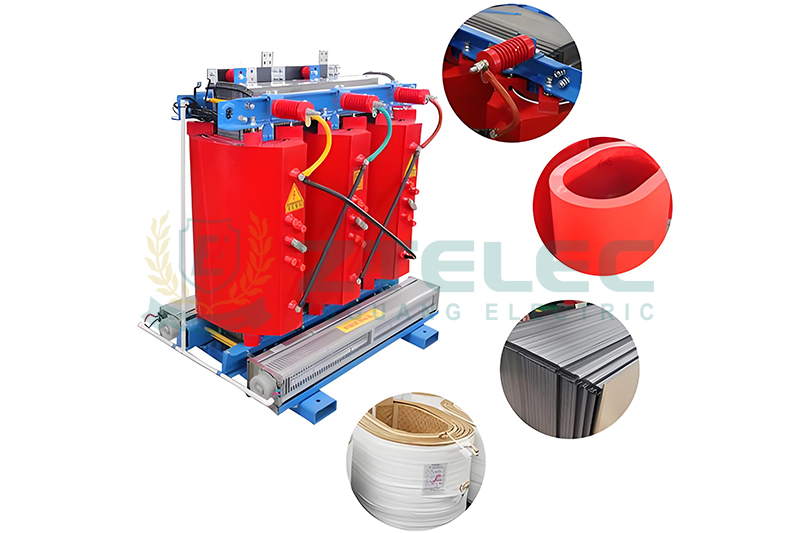
Harmonic Mitigation: A Critical Design Factor
Nonlinear loads in data centers generate significant harmonic distortion, increasing transformer losses and thermal stress. Third, fifth, and seventh harmonics are particularly impactful.
In addition to selecting high K-factor transformers, harmonic filters such as passive LC filters or active power filters can be deployed. These solutions help maintain total harmonic distortion within recommended limits and significantly reduce additional losses.
Accurate harmonic measurement over a continuous period is essential before transformer selection to ensure proper K-factor specification and avoid long-term overheating risks.
Installation Environment and Cooling Requirements
Dry-type transformers rely on air cooling, making ventilation design critical. Adequate clearance around the transformer ensures proper airflow and heat dissipation.
Transformer rooms should incorporate bottom air intake and top exhaust to create natural convection. Where necessary, forced ventilation systems must be installed based on transformer losses.
Ambient temperature should remain below 40°C, and altitude derating must be considered for installations above 1000 meters. Dust and moisture control are also essential to prevent insulation degradation and partial discharge risks.
Noise control measures such as vibration isolation and flexible connections help minimize operational impact in indoor environments.
Redundancy and Reliability Design
Data centers typically follow Tier III or Tier IV standards, requiring no single point of failure. Transformer configurations often adopt N+1 or 2N redundancy architectures.
In N+1 setups, parallel transformers share the load, allowing one unit to handle full demand in case of failure. Tier IV designs implement full dual power paths to ensure uninterrupted operation under any single fault condition.
Integration with automatic transfer switches and real-time monitoring systems further enhances reliability and operational visibility.
Frequently Asked Questions
Dry-type transformers generally require preventive maintenance every two to three years, including insulation testing and visual inspection. Daily operation relies on monitoring systems rather than frequent shutdowns.
K-20 transformers typically cost 15% to 25% more than K-13 units due to increased conductor material, but the improved efficiency often offsets the investment over time.
Dry-type transformers can be installed داخل buildings, provided proper ventilation, fire protection, and dedicated rooms are designed according to standards.
To evaluate existing transformer suitability, harmonic measurements should be conducted and compared with the transformer’s K-factor rating. If values approach design limits, upgrading or adding filtering solutions is recommended.
Key standards for 2026 include IEC 60076-11 for dry-type transformers, IEEE 519 for harmonic control, and relevant national data center design codes.
oil immersed transformer lifespan
oil immersed transformer maintenance
transformer lifecycle
transformer insulation aging
dry type transformer temperature monitoring
- more+releated article
- 2026-05-11How Long Does an Oil-Immersed Transformer Last
- 2026-05-08Modern Power System Dry-Type Transformer Insta
- 2026-05-07Oil-Immersed Transformer Overheating: Causes,
- 2026-05-07Dry-Type Transformers for Data Centers: 2026 R
- 2026-04-30Air-Core Reactor vs Iron-Core Reactor: How to
- 2026-04-29Compact Enclosed Transformer for Smart Grid: T
- 2026-04-2812-Pulse and 24-Pulse Phase-Shifting Transform
- 2026-04-27Oil-Immersed Transformers for Industrial Plant
- 2026-04-25Why Dry-Type Transformers Are Preferred for Ho
- 2026-04-24Enclosed Transformer Outdoor Solutions: IP Pro
- ELECTRICAL INSULATION BOARD MATERIALS
- ELECTRICAL INSULATION MATERIALS
- POWER TRANSFORMER
- ENAMELED WIRE
- SWITCHGEAR



transformer insulation aging
transformer lifecycle
oil immersed transformer lifespan
oil immersed transformer maintenance
dry type transformer installation
dry type transformer temperature monitoring
dry type transformer maintenance
dry type transformer sizing
transformer cooling system failure
transformer overheating causes
oil immersed transformer overheating
transformer oil temperature
harmonic mitigation
dry type transformer
K factor transformer
data center transformer
Cast resin transformer
insulation oil degradation
DGA analysis transformer
transformer fault analysis
oil immersed transformer failure
smart grid transformer
compact enclosed transformer
integrated distribution transformer
compact transformer substation