
Modern Power System Dry-Type Transformer Installation and Maintenance Guide
Dry-type transformers are now widely used in industrial plants, commercial buildings, metro stations, hospitals and data centers. Compared with traditional oil-immersed transformers, dry-type transformers require no insulating oil, eliminate leakage risks and provide superior fire safety performance. These advantages make them especially suitable for indoor installations and densely populated areas.
However, many projects overlook the importance of proper installation conditions, ventilation design and long-term maintenance. Although dry-type transformers appear structurally simple, reliable long-term operation depends heavily on standardized installation and continuous maintenance management.
This article provides a comprehensive overview of the entire lifecycle management of dry-type transformers, including equipment selection, site installation, routine maintenance and common fault handling in modern power systems.
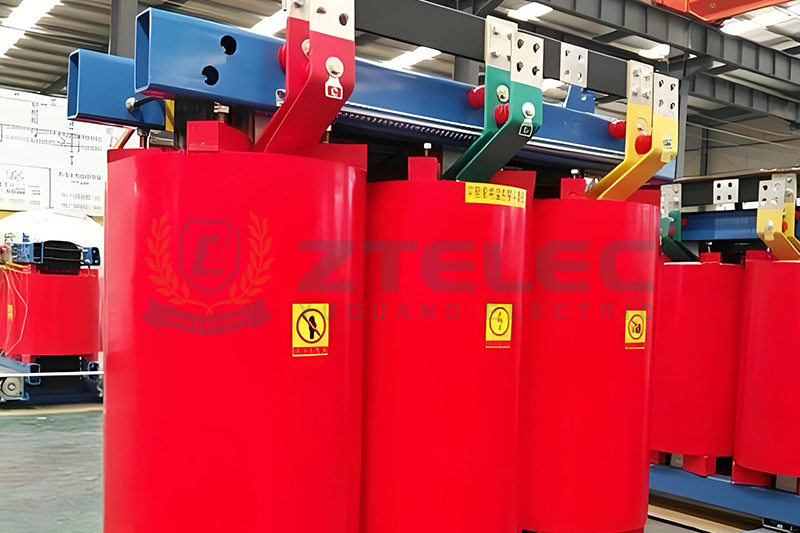
Before Installation: Transformer Selection and Environmental Evaluation
Capacity and Voltage Matching
Dry-type transformer sizing should be based on actual load calculations, including demand factor, diversity factor and future expansion requirements.
A common engineering mistake is simply adding together the rated power of all electrical equipment, resulting in oversized transformer selection. This increases initial investment costs and reduces operating efficiency under light-load conditions.
In most applications, the recommended long-term operating load rate is between 75% and 85%, balancing efficiency, lifespan and load fluctuation capability.
It is also essential to verify that the high-voltage and low-voltage ratings, as well as the vector group designation such as Dyn11, match the actual power distribution system to avoid phase mismatch or voltage compatibility problems after energization.
Insulation Class Selection
Modern dry-type transformers typically use either F-class insulation (155°C) or H-class insulation (180°C).
F-class insulation is widely used in commercial buildings and standard industrial applications, while H-class insulation is more suitable for high-temperature environments, metallurgical plants, mining facilities, furnace loads and continuous heavy-duty operation.
Higher insulation class provides greater thermal margin and improves transformer lifespan under demanding operating conditions.
Installation Environment Assessment
Dry-type transformers have stricter environmental requirements than oil-filled transformers, especially regarding humidity, dust and ventilation.
Because epoxy resin and insulating materials are sensitive to moisture, long-term operation in humid environments may reduce insulation resistance and eventually lead to surface tracking discharge. Relative humidity should generally remain below 95% without condensation.
Dry-type transformers rely primarily on natural air cooling or forced-air cooling. Therefore, transformer room ventilation design, air inlet and outlet sizing and installation clearances directly affect operating temperature.
In most installations, the transformer body should maintain at least 600 mm clearance from walls and at least 1000 mm clearance from the ceiling, although manufacturer recommendations should always take priority.
Dust accumulation must also be carefully controlled. Ordinary dust reduces cooling efficiency, while conductive dust such as metal particles or carbon powder can lower insulation surface resistance and increase the risk of electrical discharge.
For dusty environments, enclosed dry-type transformers with IP2X or higher protection ratings are strongly recommended.
Rodent and insect protection should not be ignored either. Damage caused by rodents chewing transformer leads has resulted in many short-circuit incidents, making enclosed structures and preventive measures essential.
On-Site Installation: Key Procedures and Precautions
Unpacking and Equipment Inspection
After delivery, transformer nameplate data should be carefully checked against design specifications, including capacity, voltage, frequency, vector group and impedance values.
Inspect the transformer for transportation damage, paying close attention to insulators, winding terminals, bushings and core clamping structures for cracks, deformation or looseness.
If the transformer has been stored in a humid environment for an extended period, insulation resistance testing and drying treatment should be performed before installation.
Foundation and Positioning
The transformer foundation must remain level and have sufficient structural strength to support both static and dynamic loads.
During lifting and positioning, only manufacturer-approved lifting points should be used. Windings and insulation components must never be used as lifting points.
After positioning, transformer inclination should generally not exceed 1%.
For offices, hospitals and commercial buildings where noise control is important, vibration damping pads are recommended to reduce vibration transmission and operational noise.
High-Voltage and Low-Voltage Wiring
High-voltage cable insulation levels must match system voltage ratings, and phase sequence must be verified carefully during installation.
On the low-voltage side, high operating currents require adequate busbar sizing and proper tightening torque for all bolted connections. Poor contact is one of the most common causes of overheating on low-voltage terminals.
All electrical connections should be tightened using torque wrenches according to manufacturer specifications to prevent long-term thermal loosening.
Grounding System
Transformer core, enclosure and low-voltage neutral point must be reliably grounded.
Grounding conductor cross-sectional area must meet short-circuit current requirements and should never be arbitrarily reduced.
Proper grounding is critical not only for personnel safety but also for reliable protective relay operation.
Pre-Energization Testing
Before energization, insulation resistance testing, turns ratio testing, vector group verification and no-load operation checks should all be completed.
During no-load energization, special attention should be paid to abnormal vibration, unusual odor, partial discharge or irregular noise.
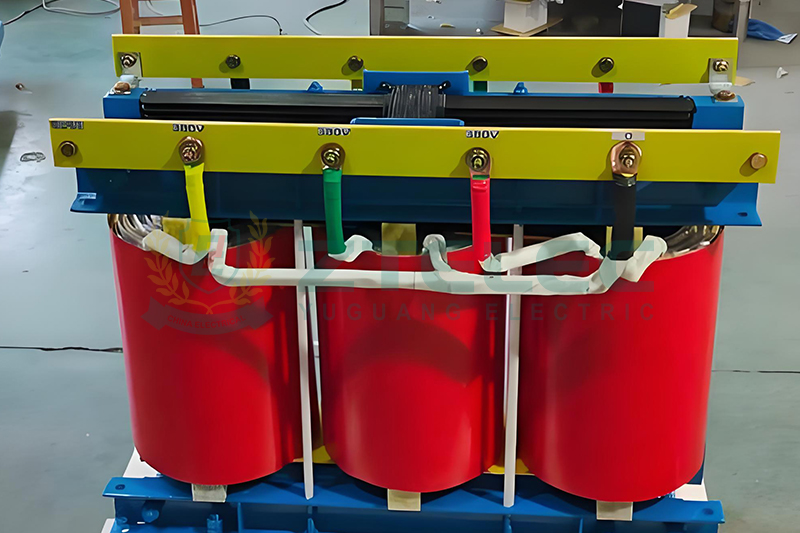
Routine Operation and Maintenance of Dry-Type Transformers
Temperature Monitoring and Regular Inspection
Many people misunderstand dry-type transformers as completely maintenance-free equipment. In reality, “maintenance-free” mainly means no oil replacement is required, not that maintenance itself is unnecessary.
Routine inspections should include winding temperature, cooling fan operation and changes in transformer operating sound.
Under normal conditions, transformer noise should remain stable and uniform. Irregular vibration, metallic noise or discharge cracking sounds require immediate investigation.
Modern dry-type transformers are commonly equipped with PT100 temperature sensors for real-time winding temperature monitoring and over-temperature alarm functions.
Integrating temperature monitoring systems into power automation platforms is recommended for remote supervision and historical trend analysis.
Periodic Cleaning Maintenance
Depending on environmental conditions, internal cleaning should generally be performed every six months to one year.
Dust and debris should be removed from winding surfaces, core structures, ventilation ducts and cooling channels.
Cleaning should be performed using dry compressed air or soft brushes. Wet cloths must never be used directly on insulation surfaces.
During maintenance, insulation surfaces should also be inspected for cracks, discoloration, aging or discharge marks, while critical bolted connections should be rechecked for proper torque.
Insulation Resistance Testing
Dry-type transformers should undergo insulation resistance testing at least once per year.
If insulation resistance drops significantly compared with historical values, moisture ingress or insulation deterioration is usually suspected and requires further analysis.
Moisture-contaminated transformers may be dried using low-load heating or external hot-air drying methods.
Partial Discharge Detection
Dry-type transformers operating for more than ten years should undergo periodic partial discharge testing.
Partial discharge is an important early indicator of insulation deterioration and helps identify hidden insulation defects before catastrophic breakdown occurs.
Transformers previously exposed to overload, short-circuit events or overvoltage conditions should receive enhanced partial discharge monitoring.
Common Dry-Type Transformer Faults and Solutions
Abnormal Temperature Rise
When abnormal overheating occurs, the first step is to verify whether the transformer is overloaded and whether cooling fans and ventilation systems are operating properly.
If external cooling conditions are normal, internal winding faults such as inter-turn short circuits should be investigated.
Abnormal Vibration and Noise
Loose silicon steel laminations in the transformer core are a common cause of increased vibration and noise.
If vibration varies significantly with load changes, harmonic current levels should also be analyzed to determine whether harmonic distortion is contributing to additional vibration.
Surface Tracking Discharge
Carbonized traces on winding surfaces are usually caused by long-term contamination or moisture exposure.
Minor carbonization may be repaired through cleaning and insulation varnish treatment, while severe damage may require winding replacement evaluation.
Low-Voltage Terminal Overheating
Low-voltage connection overheating is typically caused by oxidation, poor crimping or insufficient tightening torque.
Maintenance should include cleaning oxidation layers, replacing damaged washers and retightening all connections to specified torque values.
For copper-to-aluminum connections, copper-aluminum transition connectors should be used to prevent galvanic corrosion.
How to Extend Dry-Type Transformer Service Life
The design life of dry-type transformers generally exceeds 20 years, but many units fail prematurely because of overload operation, poor environmental conditions or inadequate maintenance.
Long-term overload operation is one of the most critical factors affecting insulation lifespan. According to the well-known electrical engineering “8-degree rule,” every 6°C to 8°C increase in winding temperature approximately halves insulation life expectancy.
Therefore, proper load management, effective cooling conditions and routine preventive maintenance are far more valuable than emergency repairs after failure occurs.
Establishing complete equipment maintenance records is equally important. Long-term tracking of temperature, insulation resistance, partial discharge levels and maintenance history helps identify developing problems before major failures occur.
The core advantages of dry-type transformers lie in safety, environmental protection and installation flexibility. However, these benefits can only be fully realized through proper installation and systematic maintenance.
A dry-type transformer installed correctly and maintained consistently can operate reliably for more than twenty years. In contrast, poorly maintained equipment operating in unsuitable environments often fails unexpectedly and jeopardizes the entire power distribution system.
In modern industrial and intelligent power systems, dry-type transformers are not merely distribution equipment — they are critical infrastructure supporting reliable and stable power supply.
oil immersed transformer lifespan
oil immersed transformer maintenance
transformer lifecycle
transformer insulation aging
dry type transformer temperature monitoring
- more+releated article
- 2026-05-11How Long Does an Oil-Immersed Transformer Last
- 2026-05-08Modern Power System Dry-Type Transformer Insta
- 2026-05-07Oil-Immersed Transformer Overheating: Causes,
- 2026-05-07Dry-Type Transformers for Data Centers: 2026 R
- 2026-04-30Air-Core Reactor vs Iron-Core Reactor: How to
- 2026-04-29Compact Enclosed Transformer for Smart Grid: T
- 2026-04-2812-Pulse and 24-Pulse Phase-Shifting Transform
- 2026-04-27Oil-Immersed Transformers for Industrial Plant
- 2026-04-25Why Dry-Type Transformers Are Preferred for Ho
- 2026-04-24Enclosed Transformer Outdoor Solutions: IP Pro
- ELECTRICAL INSULATION BOARD MATERIALS
- ELECTRICAL INSULATION MATERIALS
- POWER TRANSFORMER
- ENAMELED WIRE
- SWITCHGEAR



transformer insulation aging
transformer lifecycle
oil immersed transformer lifespan
oil immersed transformer maintenance
dry type transformer installation
dry type transformer temperature monitoring
dry type transformer maintenance
dry type transformer sizing
transformer cooling system failure
transformer overheating causes
oil immersed transformer overheating
transformer oil temperature
harmonic mitigation
dry type transformer
K factor transformer
data center transformer
Cast resin transformer
insulation oil degradation
DGA analysis transformer
transformer fault analysis
oil immersed transformer failure
smart grid transformer
compact enclosed transformer
integrated distribution transformer
compact transformer substation