
YBM Pre-installed Substation: Structure and Benefits
In short: A YBM pre-installed substation puts high-voltage switchgear, a transformer and low-voltage panels in one factory-tested enclosure. It saves space, shortens installation and improves safety.
Below, we explain how it is built, how each part works and where it fits best.
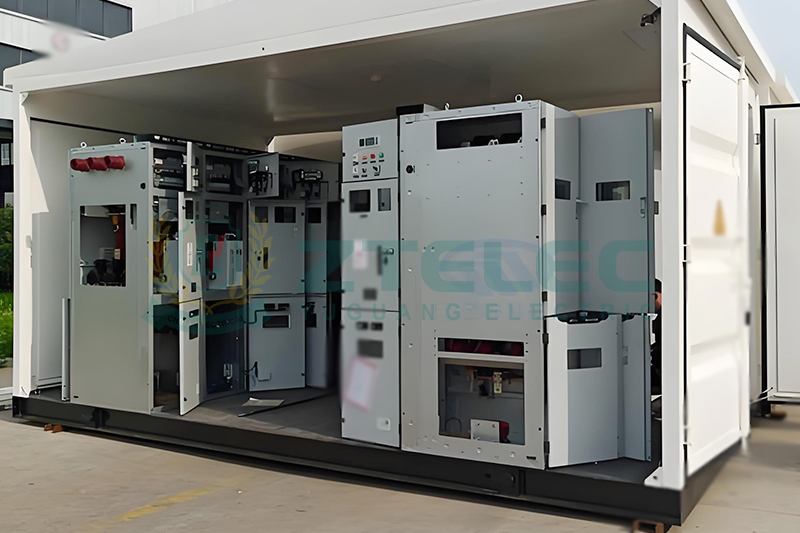
What Is a YBM Pre-installed Substation?
A pre-installed substation is also called a prefabricated substation, compact substation or box type substation.
It combines high-voltage switchgear, a distribution transformer and low-voltage switchgear in one weatherproof enclosure.
The YBM model is a widely used outdoor design of this type. It steps medium voltage, commonly in the 10kV or 11kV class, down to low voltage for end users.
Ratings vary by manufacturer, so always confirm them in the datasheet.
IEC 62271-202 is the international standard for prefabricated high-voltage/low-voltage substations. Many buyers also require compliance with the standards for the transformer and switchgear inside.
Structure of a YBM Pre-installed Substation
A typical unit has three functional compartments, plus an enclosure and supporting systems. Layouts differ by project, but the logic stays the same.
| Compartment | Main equipment | Main job |
|---|---|---|
| High-voltage | Ring main unit, load break switch with fuses, or circuit breaker | Receive, switch and protect the incoming supply |
| Transformer | Oil immersed or cast resin dry type transformer | Step the voltage down |
| Low-voltage | Main breaker, feeders, meters, capacitor bank | Distribute power to the load |
1. High-Voltage Compartment
This compartment receives the incoming medium voltage supply. It usually holds a ring main unit, a load break switch with fuses, or a circuit breaker panel.
Its job is to switch, protect and isolate the transformer.
Earthing switches and mechanical interlocks stop operators from opening a live compartment by mistake.
Cables normally enter from the bottom. Fault indicators and surge arresters can be added when needed.
2. Transformer Compartment
This compartment houses the power transformer. There are two main options.
Oil immersed transformer: high efficiency, good overload capacity and a common choice for outdoor sites.
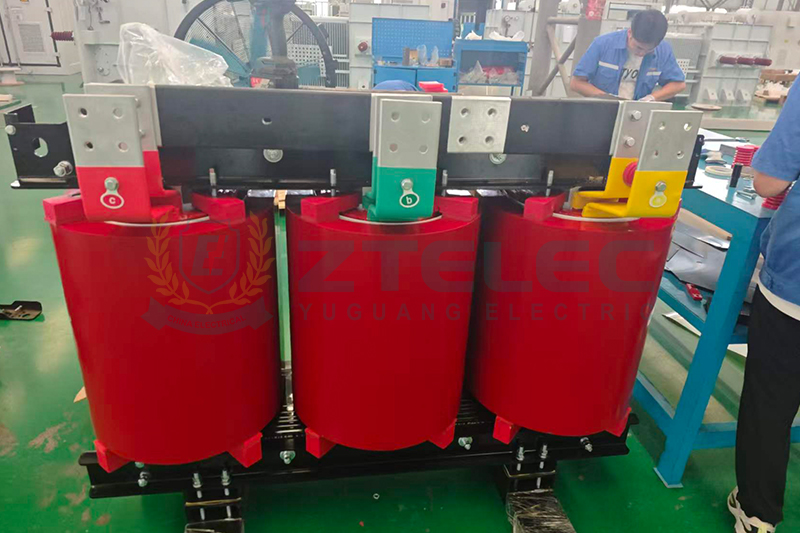
Cast resin dry type transformer: no insulating oil, so lower fire risk. It suits sites near buildings, public spaces or sensitive environments.
Ventilation openings, and sometimes fans, keep the transformer within its thermal limits. Temperature monitoring protects it during heavy loads and hot weather.
3. Low-Voltage Compartment
This compartment distributes power to the load. It usually contains a main incoming breaker, several outgoing feeders and metering.
Capacitor banks can be added to improve the power factor and reduce utility penalties.
Surge protection and monitoring devices are also common.
4. Enclosure and Base
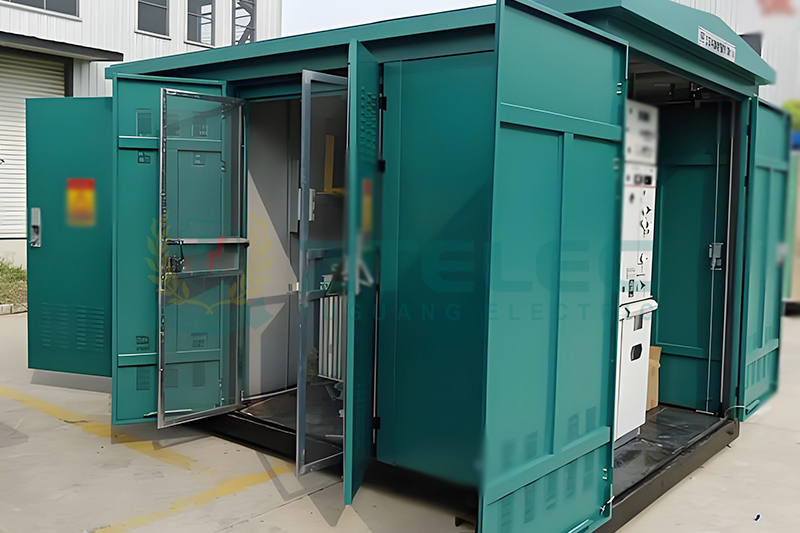
The enclosure protects the equipment from rain, dust, sun and unauthorized access.
Common materials are galvanized steel, aluminum-zinc coated steel and stainless steel. The choice depends on corrosion risk.
A double-layer roof, insulation and ventilation louvers reduce heat and condensation.
The base is usually a steel frame or concrete plinth, with space for cable entry and oil containment where needed.
5. Earthing and Auxiliary Systems
An internal earthing bar connects all metal parts to the substation earth grid.
Internal lighting and sockets support maintenance. Door switches and locks improve safety.
Oil Immersed vs Cast Resin Dry Type: Quick Comparison
| Factor | Oil immersed transformer | Cast resin dry type transformer |
|---|---|---|
| Fire risk | Needs oil containment and spacing | Lower, no insulating oil |
| Typical cost | Usually lower | Usually higher |
| Best location | Open outdoor sites | Near buildings, public or sensitive areas |
| Maintenance | Oil level and temperature checks | Keep windings and ventilation clean |
Protection and Safety Features
Electrical Protection
On the high-voltage side, fuses or a circuit breaker protect the transformer from short circuits and overloads.
On the low-voltage side, circuit breakers protect each feeder. Surge arresters limit overvoltages from lightning or switching.
Transformer Protection
Oil immersed units may include a temperature controller, an oil level indicator and a pressure relief device.
Dry type units use winding temperature sensors that raise an alarm or trip before overheating.
Mechanical Interlocks
Interlocks enforce a safe operating sequence. For example, a door cannot open until the earthing switch is closed.
Weather and Ingress Protection
Gaskets, sloped roofs and sealed cable entries keep out rain and dust. Ask the supplier for the protection rating that fits your climate.
Typical Parameters at a Glance
These are typical ranges only. Actual values depend on the supplier and the project.
| Item | Typical option |
|---|---|
| Primary voltage | 10kV or 11kV class, other voltages on request |
| Secondary voltage | 0.4kV, other levels on request |
| Transformer capacity | From tens of kVA up to around 1600kVA, larger on request |
| Transformer type | Oil immersed or cast resin dry type |
| HV switching | Ring main unit, load break switch with fuses or circuit breaker |
| LV distribution | Main breaker with several outgoing feeders |
| Frequency | 50Hz or 60Hz |
| Installation | Outdoor, on a concrete base or steel skid |
Key Benefits of a YBM Pre-installed Substation
Compact Footprint
Needs far less land. All equipment sits in one enclosure, instead of a full substation room.
This helps in dense urban areas, industrial parks and housing developments.
Faster Installation
Arrives wired and tested. On site, the contractor prepares the foundation, positions the unit and connects the cables.
This shortens the schedule for solar farms, temporary sites and new housing blocks.
Lower Civil and Labor Cost
No substation house to build. Civil work is limited to a foundation and cable trenches.
Overall cost is often lower, especially where site labor is expensive.
Factory-Tested Quality
Built in a controlled environment. Routine tests on the transformer, switchgear and wiring are done before shipment.
That means fewer surprises during commissioning.
Safety for Operators and the Public
Live parts stay enclosed. Separate compartments and interlocks keep operators away from live conductors.
With a dry type transformer, there is also no insulating oil, which reduces fire and leakage concerns near occupied buildings.
Mobility and Flexibility
Easy to relocate or expand. If the site changes, the unit can move. To add capacity, install another unit instead of rebuilding a room.
Tidy Appearance
Blends into the site. Enclosures can be painted or finished to suit parks, commercial areas and residential communities.
Adapting the Design to Harsh Sites
Not every site is mild. Share the full site conditions early, so the design matches the environment.
| Site condition | Design response |
|---|---|
| Coastal, salt air | Stainless steel or heavy coated enclosure |
| Hot climate | Larger ventilation, sun shield or forced cooling |
| Dust or desert | Filtered ventilation, sealed cable entries |
| Cold, snow | Heaters or anti-condensation measures |
| High altitude | Adjusted cooling and insulation levels |
Common Applications
YBM pre-installed substations suit any site that needs medium voltage converted to low voltage quickly and safely.
| Sector | Why it fits |
|---|---|
| Residential communities | Small footprint, neat appearance |
| Malls, hospitals, schools | Safe, quiet operation, dry type option |
| Factories and mines | Rugged enclosure, fast deployment |
| Construction sites | Movable, quick to energize |
| Solar and wind plants | Standardized units, short build time |
| Municipal infrastructure | Easy to replicate across many sites |
YBM Substation vs Conventional Substation
| Factor | YBM pre-installed substation | Conventional substation |
|---|---|---|
| Land and civil work | Small, limited | Larger, more work |
| Schedule | Short | Longer |
| Layout freedom | More standardized | Fully customizable |
| Best for | Distribution up to medium capacity | Very large or special facilities |
For most distribution projects up to the medium capacity range, the pre-installed option is the better trade.
How to Select the Right YBM Pre-installed Substation
Confirm Load and Voltage
Start with the expected load, including future growth.
Choose transformer capacity with suitable margin. Confirm primary voltage, secondary voltage and frequency with the local grid.
Choose the Transformer Type
Choose an oil immersed transformer for efficiency and cost in open outdoor locations.
Choose a cast resin dry type transformer where fire safety or environmental protection comes first.
Select the High-Voltage Scheme
A ring main unit supports loop networks. A load break switch with fuses suits simple radial feeds. A circuit breaker gives stronger protection for larger transformers.
Check Site Conditions
Altitude, temperature, humidity, salt air, dust and seismic activity all affect the design. State them in your inquiry.
Ask for Documentation and Tests
Request drawings, a single-line diagram, factory test reports and a clear scope of supply.
If the project demands it, ask for type test reports and internal arc performance.
Installation and Maintenance Tips
Installation
Prepare a level, well-drained foundation that can carry the unit weight, with cable openings in the right positions.
Keep clear access around the doors for operation and for transformer replacement.
Routine Checks
After energizing, inspect regularly for dust, corrosion, loose connections, abnormal heat and blocked ventilation.
For oil immersed units, monitor oil level and temperature. For dry type units, keep windings clean and the ventilation path clear.
Testing
Test protection devices and earthing at the intervals recommended by the manufacturer and local rules.
From Factory to Site: The Typical Process
Step 1: Design and Confirmation
The supplier prepares a single-line diagram, layout drawing and equipment list. The buyer confirms them before production starts.
Step 2: Factory Assembly and Testing
The unit is assembled, wired and tested. Routine tests cover the transformer, switchgear, interlocks and control circuits.
Step 3: Packing and Transport
The unit is secured for shipment, with lifting points and protection for doors and louvers. Check the transport size and weight against road and crane limits.
Step 4: Site Installation and Commissioning
The unit is lifted onto the foundation and the cables are connected. Final checks confirm insulation, protection settings and earthing before energizing.
Frequently Asked Questions
Is a pre-installed substation the same as a prefabricated substation?
The terms are closely related. Both describe a substation assembled and tested in a factory.
Names such as compact substation and box type substation are also used. The exact meaning can vary by region and manufacturer.
Can the transformer be replaced later?
Yes, if the enclosure design allows access.
Plan door size, lifting points and clearances at the design stage, so a replacement does not mean dismantling the unit.
Which is better, oil immersed or dry type?
Neither wins in every case.
Oil immersed transformers usually cost less and handle outdoor duty well. Dry type transformers cost more but reduce fire and environmental risk.
Can a YBM substation be customized?
In most cases, yes. You can request different capacities, voltage levels, switchgear schemes, enclosure materials, colors, metering and monitoring.
Provide project drawings and load data to get an accurate quotation.
A YBM pre-installed substation brings high-voltage switchgear, a transformer and low-voltage distribution into one factory-tested package.
It saves space, shortens schedules and reduces site risk. That is why it is a popular choice for modern distribution projects.
Planning a project? Send us your voltage levels, capacity, transformer type and site conditions.
We supply pre-installed substations, prefabricated substations, oil immersed transformers, cast resin dry type transformers and high-voltage switchgear, and can prepare a quotation for you.
YBM pre-installed substation
prefabricated substation
compact substation
box type substation
pre-installed substation
- more+releated article
- 2026-11-27YBM Pre-installed Substation: Structure and Be
- 2026-11-26Dry Type Transformers for Data Centers: Buyer
- 2026-11-251500 kVA Oil Filled Transformer Buying Guide |
- 2026-11-24500kVA Substation Buying Guide for 2026
- 2026-11-23Top Dry Type Transformer Manufacturers in Chin
- 2026-11-21750 kVA Oil Filled Transformer: Specs and Pric
- 2026-11-20Prefab Substation vs Traditional Build: Cost C
- 2026-11-19Dry Type Transformer Price List 2026: What to
- 2026-11-18Oil Filled Self Cooled Transformer: ONAN Basic
- 2026-11-17What Is a Prefabricated Substation? Types and
- ELECTRICAL INSULATION BOARD MATERIALS
- ELECTRICAL INSULATION MATERIALS
- POWER TRANSFORMER
- ENAMELED WIRE
- SWITCHGEAR


FR-4 Copper-Free Laminate | High-Performance Insulation Material

FR-4 Copper Clad Laminate Manufacturer & Supplier
YBM pre-installed substation
pre-installed substation
box type substation
prefabricated substation
compact substation
33kV substation design
substation design basics
33kV power transformer
33kV substation
cast resin dry type transformer
data center transformer
cast-resin transformer
dry-type transformer
dry type transformer for data centers
1500 kVA transformer buying guide
1500 kVA oil filled transformer
oil immersed transformers
500kVA substation buying guide
500kVA substation
dry type transformer manufacturers China
top transformer manufacturers China 2026
750 kVA oil immersed transformer
750 KVA oil filled transformer
750 kVA transformer price
packaged substation