
The Production Process of Epoxy Fiberglass Laminates
The epoxy fiberglass laminate is made of alkali-free fiberglass cloth impregnated with epoxy resin adhesive. Today, we’ll take a look at its production process. The first step is to prepare the pre-preg (aka. pp sheet), a composite material made from pre-impregnated fiberglass cloth as the reinforcement and a partially cured epoxy resin matrix. Pre-preg is one of the main materials for manufacturing laminates.
1. Production of Pre-pregs
1.1 Preparation for resin matrix
Add semi-finished epoxy resins, solvents and diluents, and fillers as per formulas, and mix them according to the process requirements. Main equipment is the agitated reactor, etc.
1.2 Gluing and drying
The prepared adhesive is applied to the fiberglass cloth through the gluing machine according to the technical requirements, and then the solvents are volatilized by baking and heating, so that the solids of epoxy resin are evenly covered on the base cloth. Main equipment includes the vertical gluing machine and the horizontal gluing machine.
1.3 Cutting
Cut the partially cured cloth into fixed size as per the required length, then stored them in cold areas since heat accelerates complete curing.
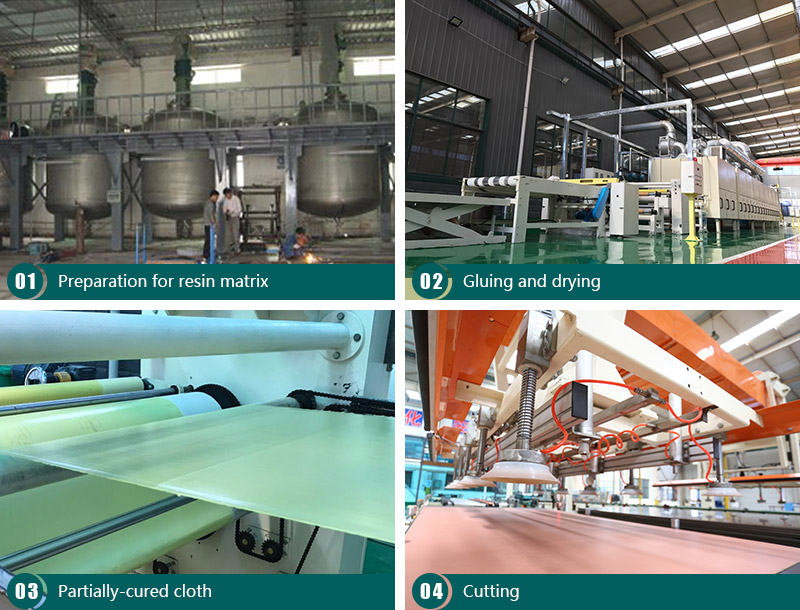
picture of Pre-preg sheets
After preparation of the semi-finished pre-preg sheets, they will be manufactured according to the technical specifications for laminated sheets. The main equipment is a hot press.
2. Production of Epoxy Fiberglass Laminated Sheets
2.1 Loading Materials
Pre-pregs of different thickness to be pressed are placed on the template as required, and then loaded into the hot press. The order of placement is: back up board, back up paper, single-sided steel plate, film, pre-preg, film, double-sided steel plate, film, pre-preg, single-sided steel plate, back up paper, back up board.
2.2 Hot Pressing
Make sure all the equipment is working in good condition and then load the materials and prepare for pressing. After the pre-heating of equipment, start heating up, press the equipment according to the process requirements, and calculate the hot-pressing time, adjust the pressure depending on the flow of the resin adhesive to ensure the product appearance, thickness as well as mechanical & electrical properties. After a required period, cooling to a certain temperature.
2.3 Cutting and Sorting
After cooling, the products are transferred to the cutting workshop, where their rough edges are cut off as per the standard size.
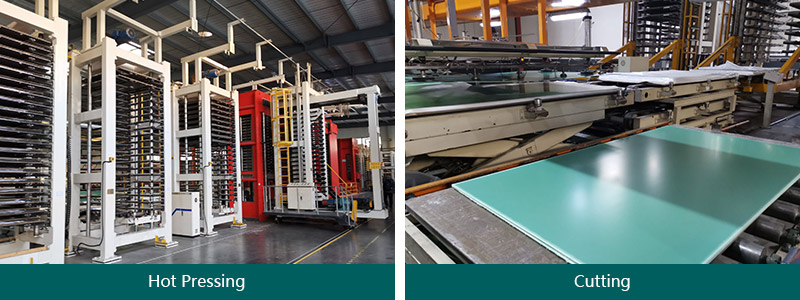
picture of the production process of epoxy sheets
oil immersed transformer lifespan
oil immersed transformer maintenance
transformer lifecycle
transformer insulation aging
dry type transformer temperature monitoring
- more+releated article
- 2026-05-11How Long Does an Oil-Immersed Transformer Last
- 2026-05-08Modern Power System Dry-Type Transformer Insta
- 2026-05-07Oil-Immersed Transformer Overheating: Causes,
- 2026-05-07Dry-Type Transformers for Data Centers: 2026 R
- 2026-04-30Air-Core Reactor vs Iron-Core Reactor: How to
- 2026-04-29Compact Enclosed Transformer for Smart Grid: T
- 2026-04-2812-Pulse and 24-Pulse Phase-Shifting Transform
- 2026-04-27Oil-Immersed Transformers for Industrial Plant
- 2026-04-25Why Dry-Type Transformers Are Preferred for Ho
- 2026-04-24Enclosed Transformer Outdoor Solutions: IP Pro
- ELECTRICAL INSULATION BOARD MATERIALS
- ELECTRICAL INSULATION MATERIALS
- POWER TRANSFORMER
- ENAMELED WIRE
- SWITCHGEAR



transformer insulation aging
transformer lifecycle
oil immersed transformer lifespan
oil immersed transformer maintenance
dry type transformer installation
dry type transformer temperature monitoring
dry type transformer maintenance
dry type transformer sizing
transformer cooling system failure
transformer overheating causes
oil immersed transformer overheating
transformer oil temperature
harmonic mitigation
dry type transformer
K factor transformer
data center transformer
Cast resin transformer
insulation oil degradation
DGA analysis transformer
transformer fault analysis
oil immersed transformer failure
smart grid transformer
compact enclosed transformer
integrated distribution transformer
compact transformer substation