
Advantages and Performance Parameters of G11 EPGC203 Laminates in Transformer and Motor Applications
In the fields of electrical insulation and mechanical manufacturing, the service life and operational safety of equipment depend largely on the judicious selection of insulating materials. Due to its excellent mechanical strength and thermal resistance, G11 (EPGC203) laminate has become a widely utilized and critical insulating material in equipment such as transformers and high-voltage motors. This article will introduce G11/EPGC203—starting with its material composition and key performance parameters—and analyze its primary advantages in transformer and motor applications.
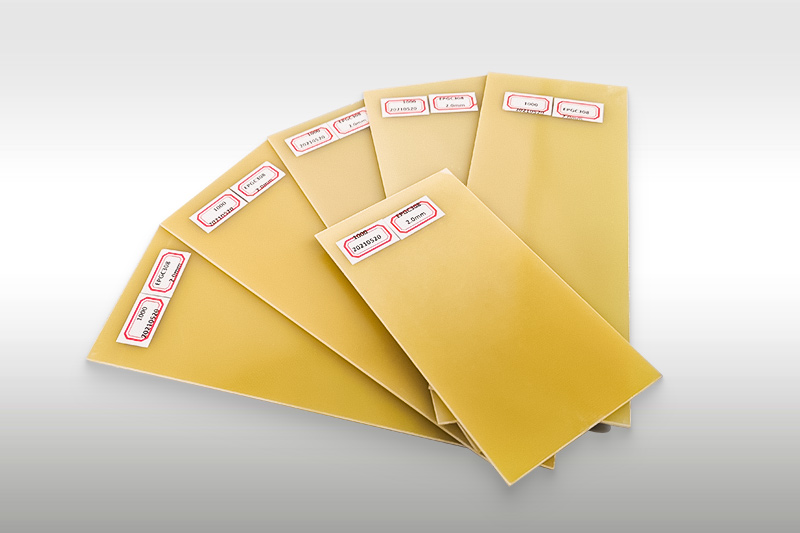
G11 is a grade designation specified under the U.S. NEMA standards, corresponding to EPGC203 in the International Electrotechnical Commission (IEC) standards. This material is manufactured through high-temperature and high-pressure molding, utilizing epoxy resin as the binder and continuous glass fiber cloth as the reinforcing material. G11/EPGC203 is classified as a rigid insulating laminate.
Compared to conventional FR4 or G10 laminates, the defining characteristic of G11 is its ability to maintain superior mechanical properties under high-temperature conditions, demonstrating a distinct advantage—particularly in terms of hot flexural strength.
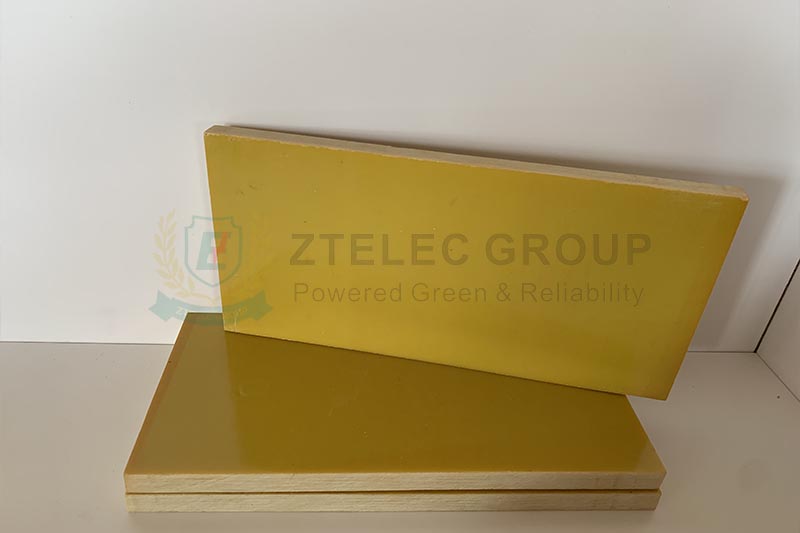
Main Performance Parameters of G11/EPGC203 (Reference)
Density: 1.95–2.05 g/cm³
Dielectric Strength: ≥ 15 kV/mm
Thermal Class: Class F (155°C)
Bending Strength: ≥ 450 MPa
Water Absorption: ≤ 0.12%
Note: Specific values may vary depending on manufacturing processes and applicable IEC/NEMA standards.
Advantages of G11/EPGC203 Laminates in Transformer Applications
During operation, transformers generate heat and electromagnetic vibrations, placing rigorous demands on their insulating materials.
1. Excellent Resistance to Short-Circuit Mechanical Shock
When a short-circuit fault occurs in a transformer, the windings are subjected to significant electrodynamic forces. G11 laminates possess high flexural strength and toughness, making them frequently utilized in components such as end insulation, insulating spacers, and yoke insulation. They are capable of withstanding instantaneous mechanical shocks to a considerable degree, thereby mitigating the risk of damage to the insulation structure.
2. Resistance to Transformer Oil and Chemical Agents
G11 laminates exhibit low water absorption and demonstrate excellent resistance to various chemical media. In oil-immersed transformers, where they are continuously exposed to high-temperature transformer oil environments over extended periods, these laminates remain resistant to issues such as hydrolysis and swelling, thereby contributing to the structural stability of the insulation system.
3. Dimensional Stability at High Temperatures
G11 retains substantial compressive strength even under high-temperature conditions reaching 180°C. When employed as material for clamping plates or as a substrate for threaded fasteners, it resists bolt loosening caused by thermal creep, thereby helping to maintain the stability of the transformer core's clamping force.
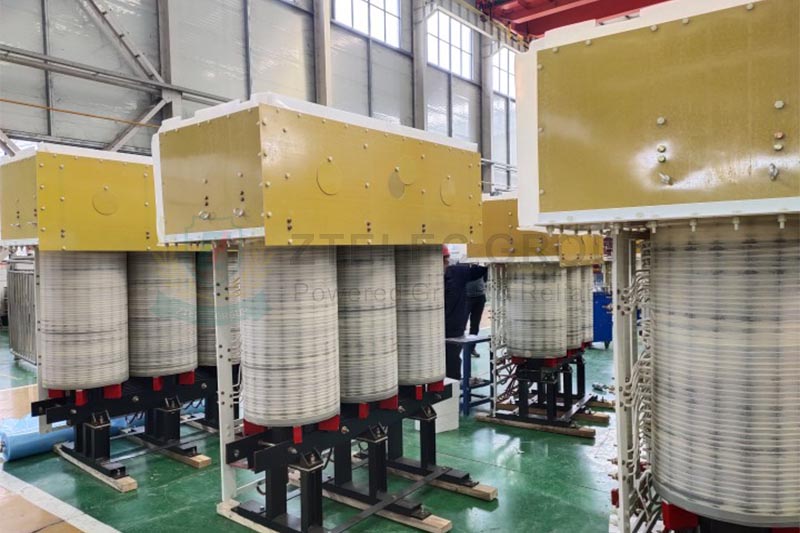
Advantages of G11/EPGC203 in Motor Applications
In high-voltage motors, traction motors, and wind turbines, G11 is frequently fabricated into slot wedges and custom-shaped insulating components.
1. An Ideal Material for Slot Wedges
Motor slot wedges are used to secure stator or rotor coils. G11 possesses high mechanical strength, allowing it to be machined into thinner wedges. This contributes to an increased slot fill factor and enhances the motor's power density. Furthermore, its excellent thermal resistance ensures that it remains resistant to softening or deformation, even during motor overload conditions or frequent start-stop cycles.
2. Mitigating High-Frequency Vibration Wear
Variable-frequency motors generate high-frequency harmonics and vibrations during operation. In G11 laminates, the glass fibers are tightly bonded with the epoxy resin, resulting in superior fatigue resistance. This property helps to significantly reduce—to a certain extent—interlayer wear or discharge damage caused by vibration.
3. Phase-to-Phase and Turn-to-Turn Insulation
At the coil ends of high-voltage motor windings, G11 can be fabricated into insulating support structures or separator plates. Its high dielectric strength helps maintain electrical isolation between individual phases, thereby minimizing the risk of creepage or insulation breakdown.
G11 vs. G10: A Selection Comparison
G10 is currently a widely utilized type of fiberglass insulation board. In transformer and motor applications, however, G11 demonstrates superior performance in terms of high-temperature resistance:
G10: Suitable for general insulation components in standard environments with temperatures below 130°C.
G11 (EPGC203): Suitable for components that must maintain a specific load-bearing capacity even under high-temperature conditions. If equipment contains high-temperature "hot spots" or if components are required to withstand thermal stress over extended periods, G11 is typically the more reliable choice.
For manufacturers of transformers and motors with stringent reliability requirements, G11/EPGC203 laminates maintain highly stable performance under conditions involving high temperatures, high humidity, or high voltage. This material complies with Class F insulation standards and possesses high mechanical strength, thereby contributing to enhanced structural safety throughout the entire lifecycle of the equipment.
As a supplier of insulation materials, we offer G11/EPGC203 sheets in standard dimensions (1020mm × 1220mm) as well as custom sizes, and we also provide processing services such as milling, punching, and grinding.
If you have technical requirements regarding transformer short-circuit protection, insulation for motors operating under high-temperature conditions, please contact us for consultation.
oil immersed transformer lifespan
oil immersed transformer maintenance
transformer lifecycle
transformer insulation aging
dry type transformer temperature monitoring
- more+releated article
- 2026-05-11How Long Does an Oil-Immersed Transformer Last
- 2026-05-08Modern Power System Dry-Type Transformer Insta
- 2026-05-07Oil-Immersed Transformer Overheating: Causes,
- 2026-05-07Dry-Type Transformers for Data Centers: 2026 R
- 2026-04-30Air-Core Reactor vs Iron-Core Reactor: How to
- 2026-04-29Compact Enclosed Transformer for Smart Grid: T
- 2026-04-2812-Pulse and 24-Pulse Phase-Shifting Transform
- 2026-04-27Oil-Immersed Transformers for Industrial Plant
- 2026-04-25Why Dry-Type Transformers Are Preferred for Ho
- 2026-04-24Enclosed Transformer Outdoor Solutions: IP Pro
- ELECTRICAL INSULATION BOARD MATERIALS
- ELECTRICAL INSULATION MATERIALS
- POWER TRANSFORMER
- ENAMELED WIRE
- SWITCHGEAR
transformer insulation aging
transformer lifecycle
oil immersed transformer lifespan
oil immersed transformer maintenance
dry type transformer installation
dry type transformer temperature monitoring
dry type transformer maintenance
dry type transformer sizing
transformer cooling system failure
transformer overheating causes
oil immersed transformer overheating
transformer oil temperature
harmonic mitigation
dry type transformer
K factor transformer
data center transformer
Cast resin transformer
insulation oil degradation
DGA analysis transformer
transformer fault analysis
oil immersed transformer failure
smart grid transformer
compact enclosed transformer
integrated distribution transformer
compact transformer substation